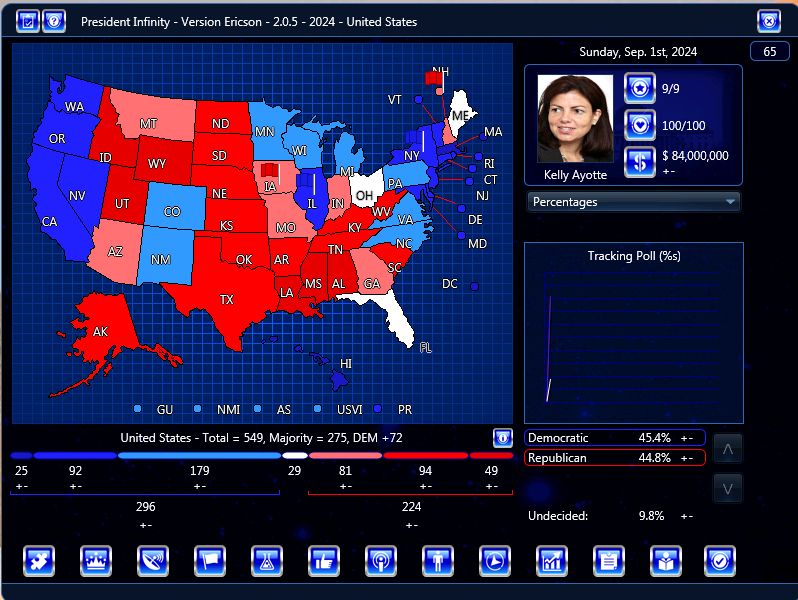
President Infinity Sentinel’s 2024 Election – Beta

2024 Sentinel Image

Short Background: This is a follow up scenario to Sentinel’s 2020 election. In 2020, Vice President Joaquin Castro loses the general election to New Hampshire Senator Kelly Ayotte. President Ayotte’s first term is both surprisingly moderate and controversial. Can she win four more years?

Please note that this scenario is still in beta. There is a lot to do still. That said, please post your election results!

Download Here: United States – 2024 [Zip]

Playable Characters:

Name (On/Off by Default)

Democrats:

Sen. Kirsten Gillibrand (On)

Gov. Julian Castro (On)

Sen. Cory Booker (on)

Sen. Cheri Bustos (On)

VP Joaquin Castro (Off)

Republicans:

President Kelly Ayotte (On)

Sen. Ted Cruz (Off)

Former VP. Brian Sandoval (Off)

Scenario Backstory:

2020 Primaries:

In 2020, President Hillary Clinton decided to forgo a run for a second term as President. Amongst a well-contested and divided field, Vice President Joaquin Castro narrowly squeaks out a victory against Senator Kirsten Gillibrand of New York for the Democratic nomination. With rumor of an economic downturn underway, Castro, in a surprise move, selects former Treasury Secretary Jack Lew as his running mate. On the Republican side, New Hampshire Senator Kelly Ayotte pulls away from the rest of the pack and secures the GOP nomination. Ayotte selects former Governor Brian Sandoval of Nevada as her running mate.

Businessmen Jeff Bezos and Donald Trump both contemplated independent runs for the White House but ultimately decided against it.

2020 General:

Facing strong headwinds for change and rumors of economic downturn, Ayotte/Sandoval defeats Castro/Lew with 289 to 256 Electoral Votes, and 53% of the popular vote to 46%.

Ayotte Presidency:

President Ayotte has had a rocky start to her Presidency. Vice President Sandoval quickly becomes embroiled in a campaign finance scandal and resigns within the first year of the Ayotte Presidency. In a surprise move picks former Central Intelligence Director George John Tenent. While there is some skepticism about his appointment, he is ultimately confirmed by the Republican Congress.

Ayotte received flak from the right of her party when she vetoed the repeal of the Affordable Care Act. In addition Ayotte would be credited with the passage of law that gave US territories one electoral vote.

By the time the 2022 Midterms come around, Ayotte is being attacked on two fronts – grassroots activism against her Administration’s policies which have barely gotten through the Republican Congress and rumors that she may fall next in the Sandoval Campaign Finance Scandal. Fortunately for the President the latter remains just a rumor, but that doesn’t stop Republicans from losing both the House and Senate.

In mid-2023, United States forces at Guantanamo Bay are attacked after the Cuban government falls after the death of Raoul Castro. Sensing an opportunity, Ayotte sends troops into Cuba without Congressional approval using the War Powers Act. The debate rages in Congress as American forces begin to occupy Cuba.

With the economy doing moderately well, can Ayotte win a second term after a controversial first term?

Download Here: United States – 2024 [Zip]

President Infinity Sentinel’s 2020 Election – Updated 8/8/2015

2020map

What: 2020 US Presidential Election

Short Background: Hillary Clinton wins the Presidency in 2016 and decides not to run for reelection. Can the Democrats hold onto the White House for another 4 years or will the GOP take the White House back?

Download Here:United States – 2020 [Zip]

***Update – 8/8/2015 – Version 1.4***

-New VP candidates include: Gov. Kim Reynolds, Gov. Doug Ducey, Fmr. Gov Mary Fallin, Fmr. Secretary Jack Lew, Gov. Gretchen Whitmer, Fmr Gov Gina Raimondo, Gov. Kate Brown
-Marco Rubio is now a potential Presidential candidate
-Edited the same sex marriage issue across the board

***Update – 7/19/2015 – Version 1.35***

-Changed storyline from having Mark Udall as Clinton’s VP to Rep. Joaquin Castro. Udall is still a candidate, but starts much lower on the totem poll. Castro obviously has moved up the totem pole.
-I’ve reworked some of the starting numbers for candidates strenght in the primaries based on if they are a former VP, former party nominee or former Vice President, former candidate or VP candidate, statewide elected officials (or high up CEOs) or a nobody….for the most part I’ve been consistent.
-I also added additional primary debates
-I love Trump, for the entertainment, so I’ve kept him as an independent candidate. I did change his bio. For better or worse, if he keeps up the 2012 antics I may keep his as an independent but weaken him significantly then add in another GOP leaning independent.

 ***Update – 6/23/2015 – Version 1.3***

-Added Condolezza Rice as a candidate for the GOP
-Added Sherrod Brown and Jon Stewart as a candidate for the Democrats
-Changed the Democratic and Republican primary schedule to start in February 2020 and make the primaries regional after the first four states (IA, NH, SC, NV).
-Added VPs: Sarah Palin, Rick Scott, Gavin Newsom, Maggie Hassan

 ***Update – 6/20/2015 – Version 1.25***

Not a big update here. Minor edits, turned Al Gore off by default as per suggestions by commenters and also put Trump & Bezo’s funds at 100 million each (prior, Bezos was higher but I wanted to balance it out).

I’ll do another update soon, as always I am reading and accepting suggestions.

***Update – 5/17/2015 – Version 1.2***

-Two US Senator Endorsers from Puerto Rico
-Updated all State Governors to reflect 2020 — minus US territories
-Added Jeff Bezos as an independent candidate. My intent was to balance out Donald Trump.
-Made Jill Stein a VP candidate for the Green Party; added two of the Green Party’s committeewomen as potential Presidential candidates
-Fixed Joaquin Castro’s photo for the most part…still makes him look a bit chubby
-Tim Scott is now off by default; Rep. Steve Chabot is now Trump’s VP

Coming Up Next: More Pres/VP candidates, feel free to suggest them. If anyone has any suggestions on fleshing out new policy/issues, let me know.

***Update – 4/29/2015 – Version 1.1***

Whats New in Version 1.1

-Added Alan Mulally as a potential Democratic candidate
-Fixed Endorser Tags [i.e Mark_Kirk –> Tammy_Duckworth]
-Added Republican VPs: Marco Rubio, Cathy McMorris Rodgers, Jon Huntsman
-Added Democratic VPs: Bill Nye, Kamala Harris, Gary Locke
-Changed Observation Party images to generic ones
-Fixed Castro’s image
-Some of the new images for candidates/vps might be slightly off. Will have to amend in future.

-Changed to .zip format

If anyone has numbers on how state political affiliation demographics are expected to change in the next few years feel free to send it my way.

Playable Characters:

Name (On/Off by Default)

Democrats:

President Hillary Clinton (Off)

VP Joaquin Castro (On)

Sen. Elizabeth Warren (On)

Sen. Kirsten Gillibrand (On)

Sen. Cheri Bustos (On)

Sen. Tim Kaine (On)

CEO Alan Mulally (On)

Sen. Sherrod Brown (On)

Fmr. Sen. Mark Udall (On)

Former VP Al Gore (Off)

Gov. Andrew Cuomo (Off)

Sen. Chuck Schumer (Off)

Former VP Joe Biden (Off)

Jon Stewart (Off)

Republicans:

Sen. Rand Paul (On)

Gov. Scott Walker (Off)

Sen. Kelly Ayotte (On)

Rep. Paul Ryan (On)

Gov. Susana Martinez (On)

Sen. Joni Ernst (On)

Gov. Mike Pence (On)

Gov. Nikki Haley (On)

Gov. Brian Sandoval (On)

Sen. Ted Cruz (On)

Rep. Louie Gohmert (On)

Fmr. Sec. of State Condolezza Rice (Off)

Sen. Tim Scott (Off)


Scenario Backstory:

Democratic Nomination

In 2016, Hillary Clinton barely defeats Martin O’Malley in Iowa – soon after she sweeps the remaining early primary states and goes onto being the uncontested Democratic nominee. She picks Congressman Joaquin Castro as her running mate.

Republican Nomination

In 2016, The GOP primary field is overly packed – Scott Walker pulls out a bare bones win in Iowa, but loses to Rand Paul in New Hampshire. South Carolina goes to Walker and Paul picks up Nevada more or less making the GOP nomination a two man race. The contest becomes bitterly contested but Walker pulls it off in the end. Word leaks that Paul turned down Walker’s offer for VP hurting the GOP nominee. Walker selects Kelly Ayotte as his running mate.

2016 General

Running on an upswing economy as a centrist Hillary Clinton defeats Governor Scott Walker 55% to 45% despite winning the Electoral College 297-241

2016 Senatorial Freshman & Pickups Winners:

Florida: Patrick Murphy (D-pick up)

Illinois: Tammy Duckworth (D-pick up)

Indiana: Marlin Stutzman (R-hold)

Louisiana: John Kennedy (R-hold)

Nevada: Catherine Cortez Masto (D-hold)

Maryland: Chris Van Hollen (D-hold)

Pennsylvania: Joe Sestak (D-pick up)

Wisconsin: Russ Feingold (D-pick up)

Picking up 4 seats gave Democrats 48 seats in the Senate, plus two independents gave them 50 seats. Vice President Udall would be the tie-breaking vote for control of the Senate. Democrats pickup 30 seats in the House, giving them a barebones majority.

2018 Senatorial Freshman & Pickups Winners:

California: Alex Padilla (D-hold)

Illinois: Cheri Bustos (D-hold)

Indiana: Brian Bosma (R-pick up)

New Jersey: Richard Codey (D-hold)

North Dakota: Kevin Cramer (R-pickup)

Utah: Mike Leavitt (R-hold)

West Virginia: David McKinley (R-pick up)

The loss of three seats gave the Republican Party a 53-49 advantage in the Senate. Republicans pickup five seats in the House handing the majority back to the GOP.

Clinton Presidency

The Clinton Presidency benefits from a Democratic Congress quickly passing immigration reform in addition to later reforming the tax code. Democrats lose a small number of seats in both houses in 2018 costing Democrats the majority in both Houses.

In 2019, Clinton announces that she will not seek reelection leaving the field wide open. Pundits speculate that Clinton believes the economy will stop expanding around the time of the election and thus ensuring a Republican victory.

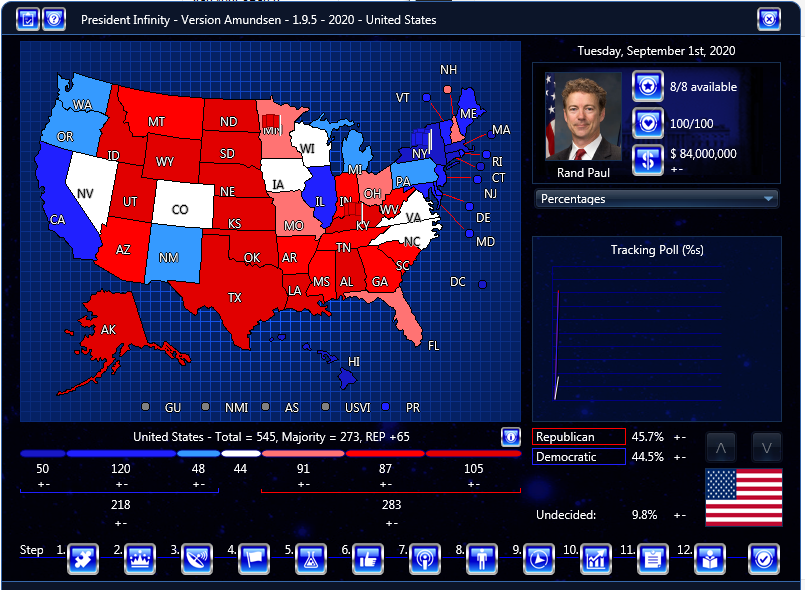
Disclaimer: I made this for fun, this is not a prediction of the future. I am open to suggestions, etc.

Download Here:United States – 2020 [Zip]



United States – 2016 (expanded – minor parties)

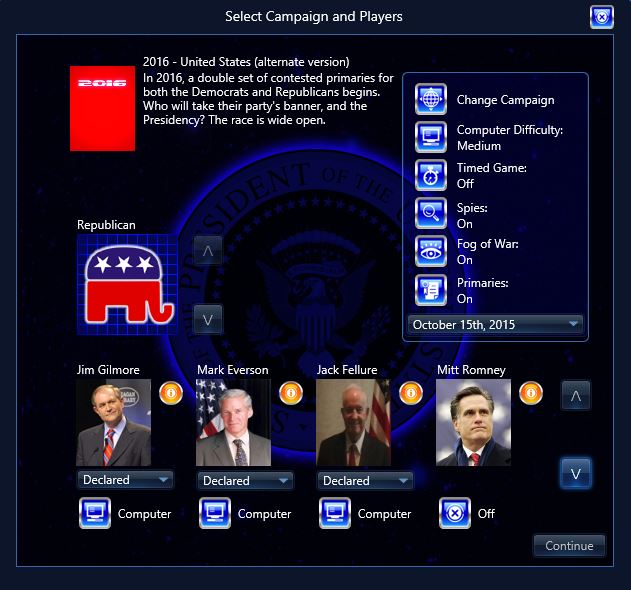
Hi fellow PI gamers. 🙂

interface

I started to make an expanded 2016 scenario. I added all minor parties and independents mentioned on Wikipedia. I gave them only ballot access in their home state, because I don’t know where they will be on in the real election. But I will update my scenario when further information will be available.

United States – 2016 (alternate version)

Please support me with your feedback and of course I plan to make further expanded elections based on Wiki information.

When the map-editor will be available I plan to make other scenarios such as Gubernatorial elections as well.

Have fun,

Luki (Conservative Elector 2) 🙂

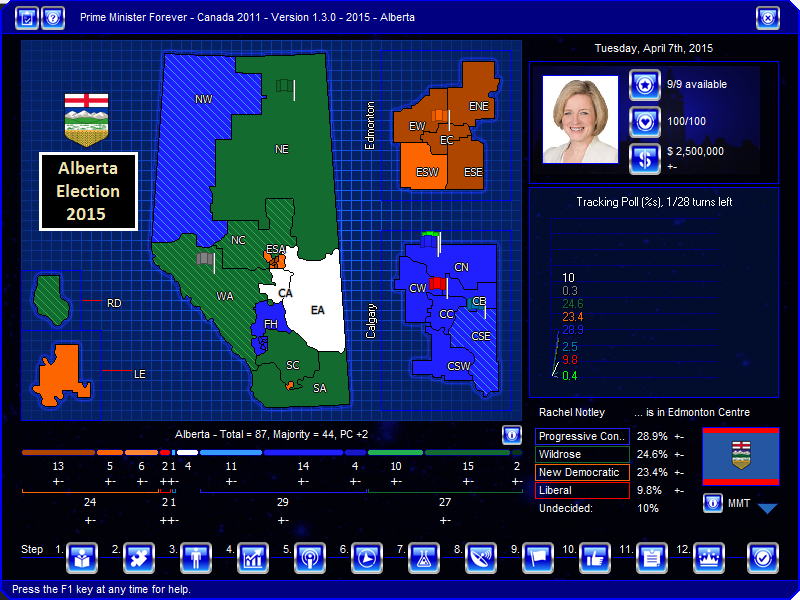
Alberta – 2015

alberta2015 startup screen

Premier Jim Prentice, shortly after assuming the leadership of Alberta’s long-established Progressive Conservatives, has introduced a tough budget and called an election, gambling that he can capitalize on the seeming weakness of his rivals on both the right and the left. While most expect the PCs to win, some warn that this election might finally see the end of an Albertan political dynasty.

Designed for the PM4E2011 Canada engine. Many thanks to Patine for the municipal flags.

Link to download:
https://www.mediafire.com/?vhpa2nvq8hd9h9o

(UPDATED to include a working link.)

President Infinity 1828 Election

1828L

*This scenario was greatly updated by the Historical Scenario Commission on July 21, 2017. Version 2.0 can be downloaded here: United States – 1828 v. 2.0

The 1828 election can be seen as Jackson’s revenge. In 1824, he had defeated the eventual winner, John Quincy Adams, in the popular vote and in the electoral college. However, with four candidates, no single candidate had enough electoral votes to be declared the winner. As such, the US House, which was dominated by Henry Clay, threw their support behind Adams after Clay’s endorsement, handing the election to the Mr. Adams.

Jackson feeling as if the will of the people had been defied, became the leading advocate of expanded democracy against an established elite. Heading into 1828, the popular Jackson seemed destined to defeat President Adams, whose presidency was having little success in fulfilling the Adams modernizing agenda.

The National Republican Party was formed under the leadership of Adams’s Secretary of State, Henry Clay. It was composed of supporters of John Quincy Adams, known as Adams Men, and other men, mostly former Federalists, supporting rapid modernization in order to compete with the powerhouses of Europe. However, Adams, despite being possibly our greatest Secretary of State, was not a successful president. He had little trust in the people to make wise decisions for themselves and made this known. He also did not work well with congress, which resulted in his programs, which resembled an antebellum New Deal, from taking ground. Had Adams been successful, and if Adams won a second term, our country could have been very different by 1860, with an increased industrialization, improved infrastructure, larger nationwide education system (and high literacy rate), and possibly a closer economic and mercantile rival to Britain and France, much sooner. However, the South and West saw Adams’s programs as needlessly intrusive and had little desire to compete with foreign countries or in anyway lose their strong sense of regionalism for the sake of nationalism.

Those in favor of popular democracy were known as the Democrats. This new party was constructed under the skill and leadership of New York senator Martin Van Buren, and he gladly let General Andrew Jackson become its figurehead. Before Van Buren, the idea of political parties was something that was roundly despised, even as people were active members of either the Jeffersonian Republicans or the Federalists. Van Buren was an advocate of permanent opposition, with two sharply opposing parties battle it out nationwide. The Era of Good Feelings was at an end. Head into 1828, the new Democratic Party ran Jackson unopposed.

This election does not have a third party.

This election allows for many what-if scenarios:

  • What if the unpopular president Adams faced competition from leading politicians of his own party, such as party leader Henry Clay, New Englander Daniel Webster and war hero William Henry Harrison?
  • What if the popular war hero Andrew Jackson was challenged by leading figures of the new Democratic Party? such as party architect Martin Van Buren, disgruntled VP John C. Calhoun, Old Guard Republican John Randolph (the Ron Paul of hsi day) and former 1820 front-runner, and somewhat recovered stroke victim, William H. Crawford.
  • What if the Anti-Mason Party formed four years earlier?

Feedback is desired.

[Note: The next election I make will be 1820. I fully endorse JViking’s amazing 1824 scenario, which I had the pleasure in helping him make by providing information and advice about the candidates and issues.]


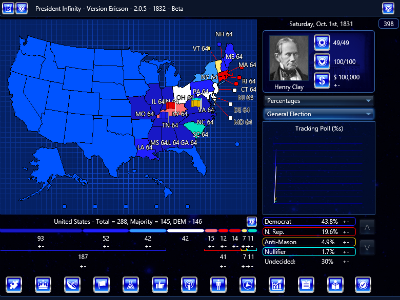
President Infinity 1832 Election

1832mapL

*This scenario has been greatly updated by the Historical Scenario Commission on July 22, 2017. Version 2.0 can be downloaded here: United States – 1832 v. 2.0

Jacksonian Democracy is all the rage. For the common man, Jackson is a godsend; for the property-owning elite, he is a demagogue. Three anti-Jackson parties emerge to stop him from winning reelection. Can three parties undo the four-year old Democratic Party, or will they merely make it much easier for the Democrats to win another four years?

The National Republicans is a new party, composed primarily of former Federalists and Adams Men (supporter of John Quincy Adams over Andrew Jackson). They hope to continue Republican values, but at a national level, hoping to blend state-lines in order to become machine that can compete with the European great powers. In this election, the unify around their leader Henry Clay.

The Democratic Party establishment supports incumbent president Andrew Jackson. He continues his war against the state banks, the elites, and against the native tribes living on the continent.

The Anti-Mason party is a mostly single-issue party of anti-Jacksonians that believe that masonic lodges are controlling the government. While they align with Jackson’s attack on elites, they have little in common with him outside of this issue. William Wirt, arguably the most influence attorney general, who had served for both Monroe and JQ Adams, is their choice for president.

The Nullifiers, or Independent Democrats, are former supporters of Andrew Jackson that feel that the president has waged a war on States’ Rights. The select John Floyd of Virginia as their presidential choice.

The election allows for many what-if scenarios:

  • What if the anti-Jackson National Republicans rallied behind former president John Quincy Adams as the strongest option to defeat Andrew Jackson?
  • What if Daniel Webster, the icon of New England, or War of 1812 hero, William Henry Harrison competed with Henry Clay for the National Republican nomination?
  • What if John C. Calhoun was the Nullifier/Independent Democrat nominee?
  • What if Northern Democrats urged the architect of the Democratic Party, Martin Van Buren, to challenge Jackson for the nomination.

Feedback is desired.

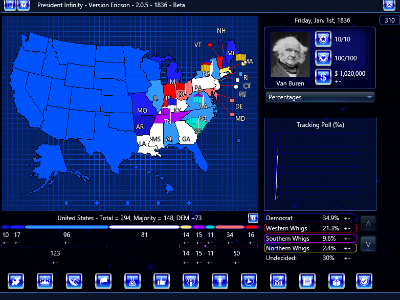
President Infinity 1836 Election

1836GEL

*This scenario has been greatly updated by the Historical Scenario Commission. Version 2.0 can be downloaded here: United States – 1836 v. 2.0

This election follows Andrew Jackson’s transformative presidency. Popular democracy, the banking system, tariffs, states’s rights are among the many issues in this election. Andrew Jackson declines a 3rd term and endorses his VP, Martin Van Buren, who had been the architect of the Democratic Party.

Note: The election does not contain a primary season.

The new Whig Party is a loose coalition of former National Republicans, Anti-Masons, Anti-Jackson’s, Adams Men, and Southern Nullifiers. As such, they are greatly disorganized, and have decided to run four candidates separately from different regions with the idea that Van Buren would get hammered in each sector by regionally popular candidates. The House would presumably select a Whig as a president in the deadlocked election, rather than selecting Van Buren. The four Whigs are General William Henry Harrison as a Western Whig, Daniel Webster as a Northern Whig, Hugh L. White as a Southern Whig and Willie P. Mangum as a Nullifier Whig.

The Democrats have unified behind Jackson’s choice of Van Buren. Jackson helped the unanimity by moving the convention so early that an opposing candidate could not be chosen.

There is no 3rd party.

This election allows for what-if scenario:

  •  What if the Whigs had unified behind a single candidate with more national range, such as Whig leader Henry Clay or former president John Quincy Adams?
  • What if John C. Calhoun ran as the Nullifier Whig?
  • What if Andrew Jackson ran for a 3rd term?

Feedback is desired.


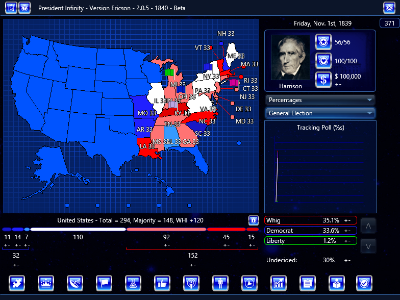
President Infinity 1840 Election

1840L

*This scenario was greatly updated by the Historical Scenario Commission on July 23, 2017. Version 2.0 can be downloaded here: United States – 1840 v. 2.0

This election takes place during the “Panic of 1837” economic depression. Economic policies under Andrew Jackson, including the removal of the national bank, are considered causes for this depression. However, as the repercussion did not occur until Van Buren’s presidency, and because Jackson was his party’s icon, the incumbent president is feeling all the heat. Van Buren, like many Democrats at the time, did not believe the federal government could constitutionally aid in helping people hurt by the economic depression. For these reasons, Van Buren and his party are not finding favor among voters going into this election.

For the Whigs, the party has decided to regroup after a blunderous campaign strategy in last election, which called for the running of four separate Whigs in the general election. This time, they’ve set their convention early with the idea of running around one of three men: General William Henry Harrison, General Winfield Scott or their party leader, Henry Clay.

For the Democrats, despite Martin Van Buren’s unpopularity, he still is the power of the Democratic Party (outside of Jackson). As such, he is the unanimous nominee in his reelection bid.

The third party is a very weak Liberty Party, which is campaigning on abolitionism.

This election allows for many what-if scenarios:

  • What if Daniel Webster tried for the Whig nomination?
  • What if the governor of New York, William H. Seward used the power of his state to win the nomination?
  • What if former president John Quincy Adams attempt a non-consecutive second term on the Whig ticket? Could his belief in government activism defeat Van Buren’s laissez faire governmental beliefs?
  • What if Van Buren had faced challengers such as James K. Polk, Lewis Cass, James Buchanan, Richard Mentor Johnson and John C. Calhoun. Could a Nullifier, such as Calhoun, or the unpopular Johnson, a slave-holder with a common law slave-wife who is the mother of his children, win the election? If Johnson won, would a slave become First Lady?
  • What if Andrew Jackson tried to save his party from defeat by running for a non-consecutive 3rd term?

Feedback desired.

Note: I thought I wouldn’t have time for another scenario before I went out of town. Obviously, I was wrong.

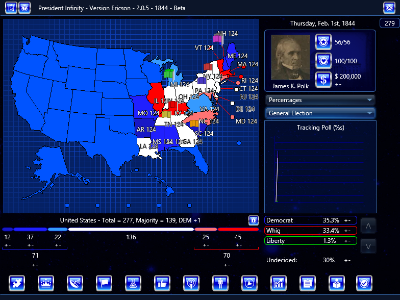
President Infinity 1844 Election

1844E

*The Historical Scenario Commission greatly updated this scenario on July 23, 2017. Version 2.0 can be downloaded here: United States – 1844 v. 2.0

America has Manifest Destiny on their mind, but they are divided on what party should lead it? How should Western land be acquired? Should slavery be contained or expanded? Should internal improvements link the East Coast to the West through federal aid? Who can lead America though its next epoch?

For the Whigs, the party is trying to rebound from it’s twin disaster of having nominated an aging Whig with a Whig-In-Name-Only as a VP in John Tyler. John Tyler has been kicked out of the party, and the party rallies behind their leader Henry Clay. He does not face an opponent for the nomination.

The Democrats, while supporting the former Whig incumbent president as someone closer to their own, has decided not to support him for reelection. Tyler thought of running as a 3rd party, but ultimately supported the Democratic nominee. The Democratic frontrunner is former president Martin Van Buren, who lost his reelection bid in 1840. In 1840, he was the unanimous nominee. However, in this election, he faces several prominent contenders, including expansionist Lewis Cass, moderate James Buchanan, the legal-minded Levi Woodbury, the eccentric Richard Mentor Johnson and nullifier John C. Calhoun.

The Liberty Party led by former slave-owner turned abolitionist James Birney is the 3rd party.

This election allows for many what-if scenarios:

  • What if incumbent president John Tyler ran with his proposed 3rd party, the National Democratic-Republican Party?
  • What if Henry Clay faced opposition for the Whig nomination by prominent and popular Whig figures, such as Daniel Webster, Gen. Winfield Scott, John M. Clayton, Judge John McLean, William Seward and the ancient former president John Quincy Adams?

Feedback is desired.

Note: I’ll be away for a week, so 1840 may not appear until after Jan 20th.


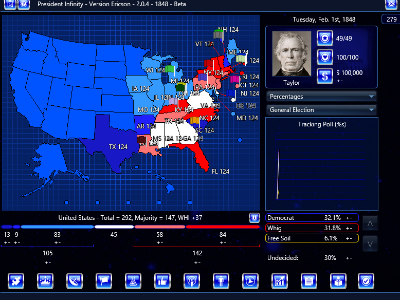
President Infinity 1848 Election

1848ElectionA

*This scenario was updated greatly by the Historical Scenario Commission on July 27, 2017. Version 2.0 can be downloaded here: United States – 1848 v. 2.0

This election follows the Mexican War, which helped secure our “Manifest Destiny,” but also intensified the rivalry between Free States and Slave States. Can the country unite behind a single president?

For the Whigs, their leader Henry Clay maintains his prominence; however, many are considering another person as a more electable candidate. As such, they promote two war heroes of the recent military engagement: Zachary Taylor and Winfield Scott. Daniel Webster, the leader of New England Whigs, maintains control of his region. John Clayton and John McLean are other prominent Whigs hoping to beat out the two inexperienced military

For the Democrats, James K. Polk fulfills his promise of not seeking a second term. With the acquisition of new territory, Lewis Cass, the land expansionist, is the front runner.  However, James Buchanan, Levi Woodbury and John C. Calhoun challenge him for the nomination.

A relatively strong third party exists under the Free Soil Party, composed of an alliance between liberal Northern Democrats and abolitionists. Former president Martin Van Buren, who was unable to gain any influence into the conservative-dominated Democratic National Convention, has emerged as the front runner of this third party. The irony is that Van Buren was the grand architect of the party he abandoned. He is challenged in this nomination by three prominent abolitionists: John P. Hale, Joshua Giddings and Charles Francis Adams, the son and grandson of the previous Adams presidents.

This election allows for many what-if scenarios:

  • What if rising Northern Whig, former governor William H. Seward ran?
  • What if 1st-term US Rep for Illinois, Abraham Lincoln ran at age 39?
  • What if Martin Van Buren had not left the Democratic Party and fought for delegates in the convention?
  • What if James K. Polk broke his promise and ran for a 2nd term?
  • What if former senator Franklin Pierce ran for president after having just served in the Mexican War?
  • What if the single-issue Liberty Party ran, rather than having joined the Free Soil Party?

Feedback is desired.