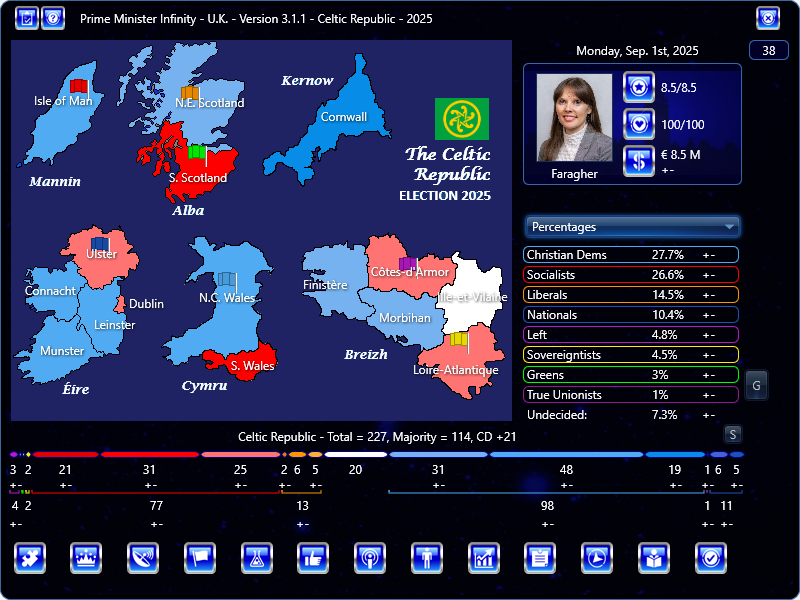
The Celtic Republic – consisting of Brittany (Breizh), Cornwall (Kernow), Ireland (Éire), the Isle of Man (Mannin), Scotland (Alba), and Wales (Cymru) – holds elections every four years under a system of mixed-member proportional representation, with half of the seats awarded by local first-past-the-post and half as levelling seats based on the party vote. For the past four years, a Christian Democratic majority government has held the reins. Cost of living, immigration, and foreign relations all weigh on the electorate’s minds as they choose the next government.
You don’t need the seat calculator for this version, but the file does contain some useful background information on the scenario: https://docs.google.com/spreadsheets/d/1xSRP_eeM-IMg_NlteIY1-g7AH0sOT5cDGzXa38FtnWk/edit?usp=drive_link
Have fun, and let me know if you find the Easter Eggs!
The Celtic Republic – consisting of Brittany (Breizh), Cornwall (Kernow), Ireland (Éire), the Isle of Man (Mannin), Scotland (Alba), and Wales (Cymru) – holds elections every four years under a system of mixed-member proportional representation, with half of the seats awarded by local first-past-the-post and half as levelling seats based on the party vote. For the past four years, a grand coalition of Christian democrats, socialists, and liberals has governed the country. Cost of living, immigration, and foreign relations all weigh on the electorate’s minds as they choose the next government.
You’ll want to use the seat calculator available here (the file also contains background information about the scenario): https://docs.google.com/spreadsheets/d/1xSRP_eeM-IMg_NlteIY1-g7AH0sOT5cDGzXa38FtnWk/edit?gid=1233407035#gid=1233407035
Have fun, and let me know if you find the Easter Eggs!
Canada’s 1962 federal election unfolds against a backdrop of economic unease, rising unemployment, and growing dissatisfaction with the leadership of Prime Minister John Diefenbaker. After his historic landslide in 1958, Diefenbaker’s Progressive Conservatives now face a restive electorate uneasy with the government’s economic management, tensions with the United States, and internal party divisions. Liberal leader Lester B. Pearson hopes to capitalize on that discontent, offering promises of stability, improved U.S. relations, and renewed economic confidence. Meanwhile, the newly formed New Democratic Party, under the leadership of Tommy Douglas, is contesting its first federal election, aiming to bring social democratic policies to the national stage. In Western Canada and Quebec, the resurgent Social Credit Party, led by Robert N. Thompson, seeks to re-establish itself as a force in Parliament with its populist economic platform. With Cold War anxieties in the air and Canadians increasingly uncertain about the country’s direction, the 1962 election promises a turbulent and a close one.
The 1998 Australian Federal Election is shaping up to be a defining moment in the nation’s political landscape.
While the Howard Government seeks re-election on the back of economic management and tax reform, the opposition Labor Party, led by Kim Beazley, is determined to capitalize on voter anxieties surrounding the proposed Goods and Services Tax (GST). However, the electoral battlefield is more complicated than a simple two-party contest, the rise of Pauline Hanson’s One Nation has shaken traditional party alignments, particularly in Queensland and rural Australia, where discontent over globalisation, immigration, and economic change is driving a populist surge. Meanwhile, the Democrats aim to position themselves as the party of moderation, promising to keep the GST in check if it passes the Senate. The Greens, still a minor force, advocate for stronger environmental policies, while the Nationals struggle with internal divisions over how to handle One Nation’s growing support in their heartland, with the Coalition banking on tax reform, Labor campaigning against it, and One Nation disrupting the status quo, this election presents a host of challenges and opportunities for every party involved.
The question now is: Who will shape Australia’s future?
Will you secure another term for John Howard, ensuring the passage of the GST and solidifying the Coalition’s control?
Can you lead Labor back into power, defeating the GST and capitalising on voter frustration with economic inequality?
Will you navigate the Democrats into a kingmaker role, balancing economic reform with social responsibility?
Can you help One Nation expand beyond Queensland, reshaping Australian politics with a populist insurgency?
Or will you bolster the Greens, pushing environmental and progressive policies into the mainstream?
The stakes are high, and the future of Australia at the turn of the millennium is in your hands.
This election is shaping up to be a challenge for the opposition, whose support appears fractured across four distinct parties. Despite their best efforts to attack the incumbent CAQ government, the opposition’s message is failing to coalesce and gain traction with voters.
With the traditional left-right divides blurring, the opposition vote is being split between a struggling Liberal party, a gasping sovereigntist movement, an ascendant left-wing Quebec Solidaire, and a conservative challenger. This division in the anti-CAQ vote is playing into the hands of the governing party, who are poised to retain power.
The once-dominant sovereigntist movement, in particular, is gasping its last breaths, as the leading separatist party fails to reignite public passion for the independence cause. Voters seem more preoccupied with pocketbook issues and the delivery of public services than the grand project of Quebec sovereignty, With some pundits had speculated about a potential political realignment.
This scenario offers you with many possibilities:
Can you Increase CAQ Majority and cement it’s dominance in Quebec politics for years to come?
Can you turn the fortune of the Liberal Party around and bring them back to government?
Can you revive the dying Parti Quebecois from falling even deeper to political irrelevancy?
Can you help Quebec Solidaire achieve their long held dream of winning 12 seats and gaining official party status?
And finally can you win the rising Conservative Party its first seat in the National Assembly?
After the return of the Chagos Archipelago, Pravind Jugnauth has called a general election to take advantage of the return of the Archipelago. Can the Militant Socialist Movement win re-election?
General elections were held in Sweden on 11 September 2022 to elect the 349 members of the Riksdag who in turn elected the Prime Minister of Sweden. Under the constitution, regional and municipal elections were also held on the same day. The preliminary results presented on 15 September showed the government parties lost their majority, which were confirmed by the final results published on 17 September. After a month of negotiations following the elections that led to the Tidö Agreement among the right-wing bloc, Moderate Party (M) leader Ulf Krirsersson was elected prime minister on 17 October. The Kristersson cabinet is a minority governmet that relies on confidence and supply from the Sweden Democrats (SD).
Parties: Social Democrats: Center left Sweden Democrats: Right wing populist to nationalist Moderate: Center right Centre: Centrist Left Party: Left wing Green Party: Center left Christian Democrats: Center right Liberals: Center right Alternative for Sweden: Far right