1992-2019 UK scenarios (Plus+)

I have taken time to redux several UK scenarios including,

United Kingdom – 1992

United Kingdom – 1997

United Kingdom – 2010

United Kingdom – 2015

United Kingdom – 2017

United Kingdom – 2019

(Note: a 2024 scenario is upcoming, and is currently being actively developed by me.)

The reason these are “reduxes” is that I took it upon myself to add further context to the candidates’ profiles, their ideological positioning, the polling in each election, alternate candidates, updated issues that are coherent to the respective election, many unique alternative-history and real-life events, and some touch-ups to the visual aspects of these scenarios, such as candidate pictures, colors, and so on.

Some specific examples of changes and additions I made are David Miliband as an alternate Labour leader in the 2015 election, Gordon Brown as an alternate Labour leader, and Michael Portillo as an alternate Tory leader in the 1997 election.

I also want to heartily thank everyone who worked on these scenarios. In some cases, they were “base” scenarios, such as 2017 or 2010, and in other cases they were based on user scenarios, such as 1992 or 1997. Again, full and unlimited credit goes to them.

I am also currently working on several other scenarios, including 1983, 1987, and 2005, but the work on those respective scenarios is still ongoing, and I do not feel they are ready to be released. I would also like to release a 2001 scenario, which currently does not have one, likely due to the boring nature of the election, but regardless, it would be nice for every election to have a respective scenario. I would also like to make a 2007 alternate-history scenario in which Brown called an election.

DOWNLOADS:

United Kingdom – 1992 (Plus+)

United Kingdom – 1997 (Plus+)

United Kingdom – 2010 (Plus+)

United Kingdom – 2015 (Plus+)

United Kingdom – 2017 (Plus+)

United Kingdom – 2019 (Plus+)
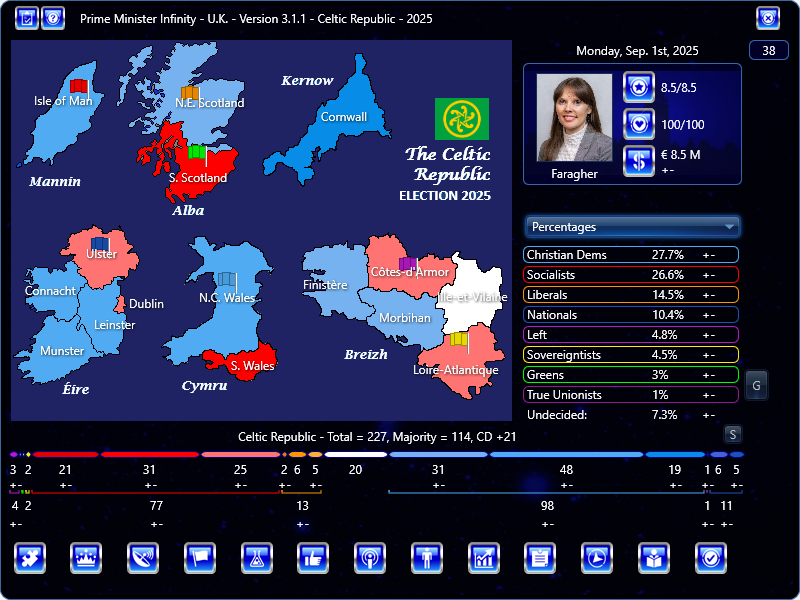
Celtic Republic – 2025 – Instant Runoff Version

The Celtic Republic – consisting of Brittany (Breizh), Cornwall (Kernow), Ireland (Éire), the Isle of Man (Mannin), Scotland (Alba), and Wales (Cymru) – holds elections every four years under a system of mixed-member proportional representation, with half of the seats awarded by local first-past-the-post and half as levelling seats based on the party vote. For the past four years, a Christian Democratic majority government has held the reins. Cost of living, immigration, and foreign relations all weigh on the electorate’s minds as they choose the next government.

The scenario is available for download here.

You don’t need the seat calculator for this version, but the file does contain some useful background information on the scenario:
https://docs.google.com/spreadsheets/d/1xSRP_eeM-IMg_NlteIY1-g7AH0sOT5cDGzXa38FtnWk/edit?usp=drive_link

Have fun, and let me know if you find the Easter Eggs!

Celtic Republic – 2025 – Proportional Representation Version

The Celtic Republic – consisting of Brittany (Breizh), Cornwall (Kernow), Ireland (Éire), the Isle of Man (Mannin), Scotland (Alba), and Wales (Cymru) – holds elections every four years under a system of mixed-member proportional representation, with half of the seats awarded by local first-past-the-post and half as levelling seats based on the party vote. For the past four years, a grand coalition of Christian democrats, socialists, and liberals has governed the country. Cost of living, immigration, and foreign relations all weigh on the electorate’s minds as they choose the next government.

The scenario itself is downloadable here.

You’ll want to use the seat calculator available here (the file also contains background information about the scenario):
https://docs.google.com/spreadsheets/d/1xSRP_eeM-IMg_NlteIY1-g7AH0sOT5cDGzXa38FtnWk/edit?gid=1233407035#gid=1233407035

Have fun, and let me know if you find the Easter Eggs!

Canada – 1962

Canada’s 1962 federal election unfolds against a backdrop of economic unease, rising unemployment, and growing dissatisfaction with the leadership of Prime Minister John Diefenbaker. After his historic landslide in 1958, Diefenbaker’s Progressive Conservatives now face a restive electorate uneasy with the government’s economic management, tensions with the United States, and internal party divisions. Liberal leader Lester B. Pearson hopes to capitalize on that discontent, offering promises of stability, improved U.S. relations, and renewed economic confidence. Meanwhile, the newly formed New Democratic Party, under the leadership of Tommy Douglas, is contesting its first federal election, aiming to bring social democratic policies to the national stage. In Western Canada and Quebec, the resurgent Social Credit Party, led by Robert N. Thompson, seeks to re-establish itself as a force in Parliament with its populist economic platform. With Cold War anxieties in the air and Canadians increasingly uncertain about the country’s direction, the 1962 election promises a turbulent and a close one.

Australia – 1998

The 1998 Australian Federal Election is shaping up to be a defining moment in the nation’s political landscape.

While the Howard Government seeks re-election on the back of economic management and tax reform, the opposition Labor Party, led by Kim Beazley, is determined to capitalize on voter anxieties surrounding the proposed Goods and Services Tax (GST). However, the electoral battlefield is more complicated than a simple two-party contest, the rise of Pauline Hanson’s One Nation has shaken traditional party alignments, particularly in Queensland and rural Australia, where discontent over globalisation, immigration, and economic change is driving a populist surge. Meanwhile, the Democrats aim to position themselves as the party of moderation, promising to keep the GST in check if it passes the Senate. The Greens, still a minor force, advocate for stronger environmental policies, while the Nationals struggle with internal divisions over how to handle One Nation’s growing support in their heartland, with the Coalition banking on tax reform, Labor campaigning against it, and One Nation disrupting the status quo, this election presents a host of challenges and opportunities for every party involved.

The question now is: Who will shape Australia’s future?

  • Will you secure another term for John Howard, ensuring the passage of the GST and solidifying the Coalition’s control?
  • Can you lead Labor back into power, defeating the GST and capitalising on voter frustration with economic inequality?
  • Will you navigate the Democrats into a kingmaker role, balancing economic reform with social responsibility?
  • Can you help One Nation expand beyond Queensland, reshaping Australian politics with a populist insurgency?
  • Or will you bolster the Greens, pushing environmental and progressive policies into the mainstream?

The stakes are high, and the future of Australia at the turn of the millennium is in your hands.

Sweden election 2022

General elections were held in Sweden on 11 September 2022 to elect the 349 members of the Riksdag who in turn elected the Prime Minister of Sweden. Under the constitution, regional and municipal elections were also held on the same day. The preliminary results presented on 15 September showed the government parties lost their majority, which were confirmed by the final results published on 17 September. After a month of negotiations following the elections that led to the Tidö Agreement among the right-wing bloc, Moderate Party (M) leader Ulf Krirsersson was elected prime minister on 17 October. The Kristersson cabinet is a minority governmet that relies on confidence and supply from the Sweden Democrats (SD).

Parties:
Social Democrats: Center left
Sweden Democrats: Right wing populist to nationalist
Moderate: Center right
Centre: Centrist
Left Party: Left wing
Green Party: Center left
Christian Democrats: Center right
Liberals: Center right
Alternative for Sweden: Far right

http://campaigns.270sims.com/wp-content/uploads/2024/09/Sweden-2022.zip

Victoria – 2010

The 2010 Victorian election presents a pivotal moment as voters across the state head to the polls, this campaign sees the incumbent Labor government, led by Premier John Brumby, striving to secure a fourth consecutive term and the first of his own, should Brumby succeed, The Liberal-National Coalition, under the leadership of Ted Baillieu, aims to capitalize on key issues like public transport, law and order, and the economy, with a focus on battleground seats, the election promises to be closely fought, capturing the attention of both local and national audiences, all eyes are now on Victoria to see which party will emerge victorious and shape the state’s future, Will John Brumby succeed in winning his own mandate or will Baillieu succeed in bringing back the Liberal-National Coalition back to power after the defeat of the Kenneth government 11 years earlier?

Australia 2022 – Independent Day

This election is set to be one of the most pivotal in recent Australian history. With the nation grappling with the aftermath of a global pandemic, economic uncertainties, and pressing climate concerns, the stakes have never been higher.

The incumbent Liberal-National Coalition, led by Prime Minister Scott Morrison, faces a formidable challenge from the Labor Party under Anthony Albanese,As Australians head to the polls, key issues such as healthcare, education, and energy policy will dominate discussions.

The political landscape is further complicated by the rise of minor parties and independents, who are poised to play a crucial role in the outcome.

Voters are increasingly looking for alternatives that address their specific concerns, making this election a true test of the major parties’ ability to connect with the electorate.

Can Labor end its almost decade-long opposition and usher in a new era of governance, or will the Coalition secure another term, continuing their current policies?

New South Wales 2023 – Wind Of Change, Or Not?

This election is set to be a pivotal moment for New South Wales. As voters head to the polls, the stakes are high with Dominic Perrottet and the Liberal Party vying to secure another term amidst challenges and a strong opposition led by Chris Minns of the Labor Party, issues ranging from healthcare and education to infrastructure and housing affordability dominate the campaign, reflecting the diverse concerns of the electorate.

Labor is determined to end 12 years in opposition, presenting a renewed vision for the state and promising significant reforms. Chris Minns and his team are capitalizing on growing dissatisfaction with the current government, hoping to ride a wave of change similar to the federal election results, Labor challenge is significant there have only been two instances since World War II where Labor has won government from the opposition in New South Wales.

Smaller parties and independents also play a crucial role in this election, The Greens continue to push their environmental and social justice agenda, while the potential for a “teal wave”—inspired by the recent federal election—adds another layer of complexity. These independent candidates, often focusing on climate action and political integrity, could disrupt traditional voting patterns and influence key electorates.

The current government is the last of its kind in mainland Australia. After losing popular premier Gladys Berejiklian, can Perrottet hold off the red wave and stop it in New South Wales? Or will Minns deliver Labor to government after 12 years in the wilderness?

Queensland – 1998

The 1998 Queensland state election is shaping up to be one of the most unpredictable and hard-fought political contests in recent history. With a diverse array of parties and candidates vying for power, the race is wide open, and the outcome is far from certain.

The incumbent National-Liberal coalition government, which unexpectedly gaining power in 1996, is now battling to maintain its grip on power. Meanwhile, the center-left Labor Party is mounting a strong challenge, while the controversial right-wing populist One Nation party led by Pauline Hanson is making a serious push to gain a foothold in the state parliament. Smaller players like the Australian Democrats and Greens are also hoping to leverage voter discontent to secure crucial seats.

The stakes are high, with the future direction of Queensland’s policies on crucial issues like gun reform, indigenous rights, immigration, and the economy all hanging in the balance. Analysts predict record voter turnout as Queenslanders grapple with a complex and consequential set of choices.

With millions of dollars in campaign spending, fiery rhetoric, and shifting alliances, the 1998 Queensland election promises to be a dramatic and defining moment in the state’s political landscape. The final results could reverberate across the country, making this one of the most closely watched state elections in recent memory.

Who will lead Queensland into the new century?