
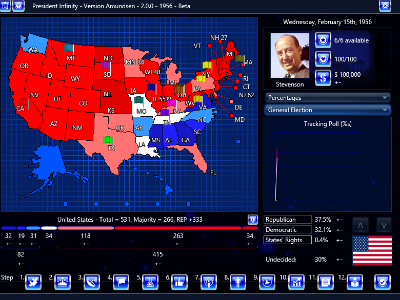
President Infinity 1944 Election

1944Election

*The Historical Scenario Commission has greatly updated this scenario, and it can be downloaded hereUnited States – 1944 v.2.0

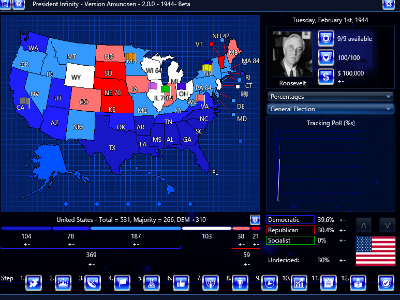
It’s 1944 and the tide of World War II has turned towards the Allied Powers; however, victory still is not certain. FDR has decided to run for a fourth term, amid speculation of ill health. The Republican Party is still having a hard time drawing votes from the popular president. However, age, an unprecedented 4th term, and FDR’s increasingly liberal policies have allowed Republicans a slight improvement in the voter base compared to 1940.

For Republicans, the clear front-runner is Thomas Dewey, the leader of the moderate Eastern establishment wing of the party. Wilkie was expected to lead the liberal wing, and Robert Taft was expected to lead the conservative wing once again. However, Wilkie had a heart attack during this election cycle and Taft decided to sit this election out and support fellow Ohioan John Bricker. With Bricker leading the conservatives, Harold Stassen led the liberal/progressive wing of the party. Additionally, General Douglas MacArthur was a candidate despite serving in World War II. Obviously, he did not campaign. Other candidates include progressive favorite son candidate for California, Earl Warren, and Rep. Everett Dirksen.

FDR was virtually assured renomination. Anti-FDR Democrats supported Harry F. Byrd of Virginia, but he did not actively campaign.

The Socialist Party is once again the strongest 3rd party.

This election has many what-if scenarios:

  • What if FDR’s Secretary of State, Cordell Hull, became a compromise option between Southern Democrats and FDR supporters?
  • What if the following Republicans have listened to their supporters and run for president: Robert Taft, Arthur Vandenberg, Henry Cabot Lodge.
  • What if Wendell Wilkie, the 1940 nominee, had not died during the election cycle?

Feedback, along with any suggestions to remedy any problems, is desired.
President Infinity 1940 Election

1940Election

*The Historical Scenario Commission has greatly updated this scenario and it can be downloaded here: United States – 1940 v.2.0

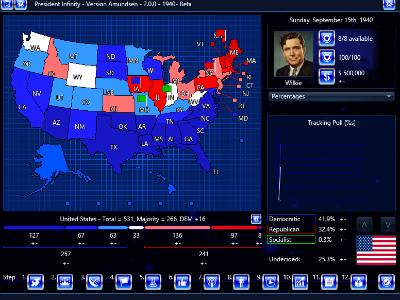
It’s 1940, and World War II is raging in the Eastern Hemisphere. Should America join in the fight to stop Germany? FDR was so popular that arguably the lead point of attacking FDR for Republicans was to convince Americans that the two-term limit (which didn’t exist at the time) was an unofficial precedent set by George Washington and should be followed.

The Republicans were heavily divided between liberal Republicans and conservatives Republicans. The front runners were Thomas Dewey (the leader of the moderate Eastern establishment) and Robert Taft (son of former president Taft and leader of the conservatives). The party eventually settled for the dark horse candidate, Wendell Wilkie, a former Democrat and businessman with no political experience. Other notable Republican candidates in the running include Arthur Vandenberg, who was one of the most powerful senators at the time, and former president Herbert Hoover. Many other candidates for the party also ran.

For the Democrats, FDR could have run virtually unopposed, but he didn’t announce that he would run until much later than when candidates usually make their announcement. This upset some of FDR’s critics, including his own VP, John Nance Garner, who would run against him and his New Deal. James Farley, FDR’s campaign manager in 1932 and 1936, thought that the presidency was rightfully his, assuming that FDR and he had intimated that he would serve the regular two-terms and then support his candidacy for office. Farley decided to launch his campaign anyway. Millard Tydings was a candidate non-Southerners opposed to FDR’s New Deal.

The Socialist Party was once again the largest 3rd party.

What-if scenarios in this election include:

  • What if the Republican nominee from 1936, Alf Landon, ran again?
  • William Borah, the progressive Republican icon, was expected to make a run, but he suddenly died. What if he had not?
  • Many wanted Teddy Roosevelt Jr to run against his distant cousin. What if he had?
  • Many conservative Republicans wanted John Bricker to run. What if he had?
  • Fiorello LaGuardia was arguably the most popular mayor in the history of New York City. He was a supporter of much of FDR’s New Deal policies. Could he have won over independents to his side?
  • Some wanted Henry Cabot Lodge Jr, the grandson of one of the most powerful Republican Senators, to run for the presidency.
  • FDR’s Secretary of War, was a war hawk and a Republican. What if he had bolted from the cabinet to be the pro-war Republican nominee?
  • Some tried to push FDR’s Secretary of State, Cordell Hull, to run against FDR. What if he had?
  • Huey P. Long was assassinated in 1935, but he had plans to run in either 1936 or 1940 or both elections on his Share Our Wealth platform, which claimed the New Deal did not go far enough. What if was not assassinated?

Feedback, along with any suggestions to remedy any problems, is desired.
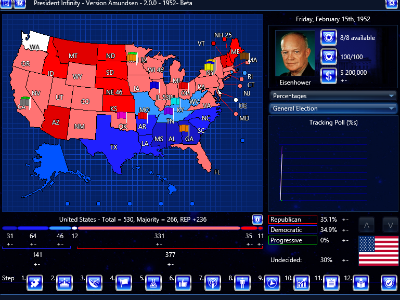
 

President Infinity 1936 Election

1936GeneralElection

*The Historical Scenario Commission greatly updated this scenario on Sep 30, 2017. It can be downloaded here: United States – 1936 v.2.0

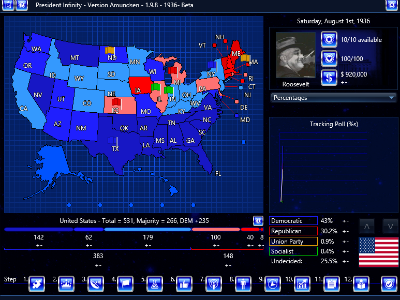
America is still caught in the Great Depression; however, most of the country has rallied behind the New Deal created by the Roosevelt administration and allied members in Congress. Roosevelt’s popularity virtually assured reelection.

For the Republicans, most of the major figures are unwilling to face certain defeat in the election. As such, Republicans rally behind a liberal alternative to FDR–Alf Landon. His only serious competitor is the progressive icon William Borah, who is even more liberal than Landon, and arguably more so than FDR.

FDR, for the most part, is running unopposed. His closest serious challenge is the inexperienced conservative anti-new deal politician Henry Breckinridge.

*Various inconsequential “Favorite Son” candidates also won delegates. They currently are not in the game, but will be added in a future update. They really won’t impact an election with two most unopposed candidates; however, they would work well in the what-if scenarios.

The Union Party and Socialist Party are the two default third parties.

This scenario allows for some What-If candidacies:

  • What if the Southerners had pushed FDR’s Secretary of State, Cordell Hull, to run as a Southern moderate compromise choice against FDR?
  • What if FDR’s VP, John Nance Garner of Texas, an anti-New Dealer, had run against FDR in 1936 instead of waiting for 1940?
  • What if the ambitious populist, Huey P. Long, had not been assassinated in 1935 and ran as a Democrat instead of under his proposed 3rd party?
  • What if Huey P. Long was not assassinated and ran under his proposed progressive party, Share Our Wealth. This party believed that the New Deal did not go far enough, and that certain basic needs must be provided. None should be too rich and none should be too poor–every man a king.
  • Some Republicans were trying to push Herbert Hoover to run against FDR again. What if he had ran?
  • Robert Taft, a leading conservative Republican voice and son of former President Taft, had supporters urging him to run. What if he had listened to the calls for his candidacy?
  • Arthur Vandenberg, one of the most powerful senators of his time, was urged to run for office, but he declined as well. What if he had not?
  • Some called for Theodore Roosevelt’s son, Teddy Jr, to run in order to excite the party and invoke a time of Republican vitality. What if he had run?
  • John Bricker, an attorney in Ohio, with higher political ambitions, was a noted conservative Republican opposed to the New Deal. What if he had listened to the calls to run?

Feedback, along with any suggestions to remedy any problems, is desired.
President Infinity 1932 Election

1932GeneralElection

*This scenario has been greatly updated by the Historical Scenario Commission. It can be downloaded here: United States – 1932 v.2.0

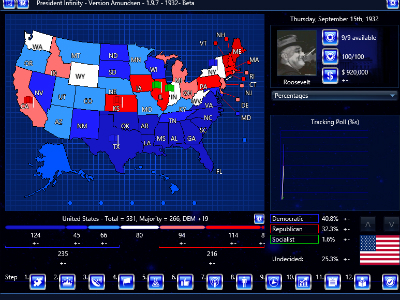
America is facing economy disaster as the Great Depression enters its third year. Will President Herbert Hoover be able to win a second term after a marred first term? Can the Democrats find a politician that can inspire optimism in one of the most trying times in US history?

For the Republicans, the incumbent Herbert Hoover has the most powerful campaign machine despite being a marred candidate. He faces only two serious challengers: John J. Blaine and Joseph France. The goal for France is to win enough delegates to lock up the convention so that former president Calvin Coolidge can be nominated as a compromise choice (Coolidge declined to enter the race personally).

The Democrats enter the race with a clear front-runner. New York Governor Franklin D. Roosevelt has the confidence and optimism that the leading Democrats are wanting in their candidate. However, FDR’s mentor and 1928 nominee, Al Smith, believes that the nomination is rightfully his. Feeling betrayed, he fights FDR just as hard as he fights the Republican administration. Another strong candidate is the conservative Speaker of the House John Nance Garner from Texas. Can FDR unite the urban and rural wings to launch an effective campaign? Other candidates include the locally popular candidates James Reed and Newton D. Baker.

Lastly, the Socialist Party is once again the strongest 3rd party.

This election allows for some what-if scenarios:

  • Former President Calvin Coolidge did not listen to the “Draft Coolidge” movement. What if he had?
  • What if former VP Charles Dawes had run?
  • What if the Republican progressive icon William Borah had listened to his supporters and run for the presidency?
  • What if the severely conservative James Wadsworth had run?
  • Some Southerners wanted Sen. Cordell Hull to make another run for the Democratic nomination.
  • Hamilton Lewis, an aged protegee of Woodrow Wilson, had many supporter wishing for him to run.

Feedback, along with any suggestions to remedy any problems, is desired.
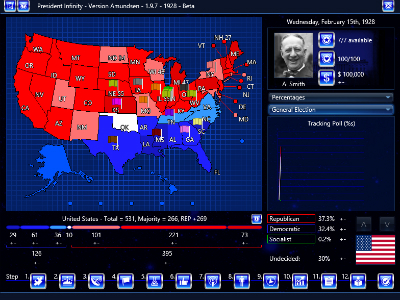
President Infinity 1928 Election

1928GeneralElection

*This scenario has been greatly updated by the Historical Scenario Commission on September 15, 2017. It can be downloaded here: United States – 1928 v.2.0

The Roaring Twenties is still raging. However, an unforeseen economic crises due in part to the high tariff of the 1920s is only a year away. President Coolidge has declined to serve another term, making the way for many Republican candidates in the 1928 election.

For the Republicans, Herbert Hoover has the closest ties to the Coolidge administration. His “Play It Safe with Hoover” campaign revolves around this connection as he attempt to be the candidate of continuity. However, Hoover, unlike the conservative Coolidge, is a moderate with some progressive tendencies. As such, he has challenges within his own party from the left and from the right. Although, Frank Lowden, another moderate, is his toughest challenger.

For the Democrats, they’ve learned that choosing a rural conservative for their ticket led to a major landslide defeat in the last election, as well as many voters flocking to La Follette’s Progressive Party. In an attempt to unify the party, the Democrats give most of their support to the leader of the urban wing of the Democratic party, Al Smith. However, Smith is a Catholic, which may scare away many severely Protestant voters. Can he overcome his drawback to his candidacy? Al Smith’s challengers are primarily Southern Democrats, who have little chance of beating Smith in the primaries.

Unlike in 1928, there is not a major 3rd party. The Socialist Party is only a fragment of its former self.

This scenario has many what-if possibilities:

  • There was a Draft Coolidge movement trying to convince him to run for another term. What if he had?
  • What if Coolidge’s VP, Charles Dawes, whom Coolidge hated, had run?
  • What if the Progressive Republican Icon, William Borah, had run. Many hoped he would have.
  • Judge Charles Evans Hughes, who was nearly victorious in 1916 against Woodrow Wilson, was still considered a possibility in 1928. However, he’s hoping to succeed former President Taft as Chief Justice of the Supreme Court.
  • What if the Progressive Democratic Icon, Thomas Walsh, had listened to his supporters and ran?
  • Some wished for Newton D. Baker, a Wilsonian Democrat from Ohio, and former Secretary of War for Wilson during World War I, to run for the presidency.
  • Lastly, what if former VP-nominee Franklin D. Roosevelt had decided to run for the presidency rather than for the Governorship of New York in 1928. FDR at this time would be no less charismatic, but his experience, leadership and organizational power is nowhere near where it will be in four years.

Feedback, along with any suggestions to remedy any problems, is desired.
President Infinity 1924 Election

1924GeneralElection

*This scenario has been greatly updated by the Historical Scenario Commission. It can be downloaded here: United States – 1924 v2.0

This election takes place in the middle of the Roaring Twenties, in what has been called “High Tide of Conservatism,” as both parties nominated conservatives. The political conservatism of the decade was a reaction to the Progressive Age, which was prevalent for two decades.

For the Republicans, Coolidge has proved popular choice after taking over the presidency after the death of the scandal-ridden Warren G. Harding, clearing out the offenders in the administration and leading during a time of economic prosperity. However, many progressive Republicans who did not like Coolidge’s inactive presidency preferred progressives such as Hiram Johnson and Robert La Follette.

The Democratic party was much less unified, which placed them at a disadvantage. Al Smith led the urban wing of the party. William Gibbs McAdoo (son-in-law of Woodrow Wilson) led the rural wing of the party. Oscar Underwood attempted to be the leader of the Democratic South. The compromise choice during the nomination fell on former ambassador John W. Davis, a conservative from West Virginia. He seemed to be the best candidate at the time to compete against a successful conservative Republican. However, his nomination upset many progressive Democrats.

A strong Progressive Party reemerged with Robert La Follette as the leader. Although, he was nominally a Republican, most of the progressives that joined his ranks, outside of Wisconsin, were Democrats that would not support Davis. As such, Coolidge won in a major landslide. The Socialist Party is still available, but much weaker in 1924.

The campaign allows for what-if scenarios:

  • What if Warren G. Harding had not died in office and attempted a second term amidst a series of major scandals?
  • Some Republicans wanted a more moderate president and pushed for popular Illinois governor Frank Lowden to challenge Coolidge for the party ticket.
  • Other possible Republican challengers include: Sec. Herbert Hoover, extreme conservative Nicholas Butler, and former 1916 nominee Judge Charles Evans Hughes.
  • Democrats also have many possible what-if candidates, including three-time nominee and populist leader William Jennings Bryan, popular progressive Thomas Walsh of Montana, brilliant Southerner Cordell Hull and New Orleans mayor Martin Behrman, a Jewish Southern politician.

Feedback, along with any suggestions to remedy any problems, is desired.
President Infinity 1920 Election

1920General

*This scenario has been greatly updated by the Historical Scenario Commission on September 15, 2017. It can be downloaded here: United States – 1920 v2.0

This historic election deals with the aftermath of World War I, as well as the reaction to the fast-moving Progressive Age. Both parties are, for the most part, less fragmented than they were in the past two elections. Both parties are also becoming more conservative. As such, Robert La Follette launches a 3rd party bid to attract progressives from both parties. The Socialist Party was declining in power, but they still fielded a candidate.

In real life, a dark horse candidate, Warren G. Harding is nominated over a field of Republican all-stars because he is the one candidate that all the delegates can accept. The Democratic ticket includes a young FDR as the VP selection, despite his inexperience. Harding wins in one of the greatest landslides in history, ending two terms of Democratic rule.

This campaign allows for many “What-if” scenarios:

  • General Pershing, the hero of World War I, was asked to run, but he declined. What if he had run?
  • The near-victor of the 1916 election, Judge Charles Evans Hughes was asked to run, but he declined. What if he had run?
  • Theodore Roosevelt was the Republican front-runner in 1919, but he died unexpectedly at the age of 60. What if he had lived?
  • William Jennings Bryan was still the influential leader of the populist wing of the Democratic Party, what if he was nominated for the fourth time?
  • Woodrow Wilson wanted to win a third-term, but his paralytic stroke prevented him from campaigning. Yet, he still hoped to be nominated at a deadlocked convention. What if President Wilson had thrown his hat in the ring despite his stroke (stamina 1)?

Feedback, along with any suggestions to remedy any problems, is desired.
President Infinity 1916 Election

1916General

[This scenario has been greatly updated by the Historical Scenario Commission on September 15, 2017. You can download it here: United States – 1916 v2.0

Woodrow Wilson attempts to become the first Democratic president to win back-to-back reelection since Andrew Jackson in 1832. This election will celebrate its centennial during the 2016 election.

In real life, Wilson was assured renomination for the Democrats. The Republican field was spread out between progressives, moderates and conservatives, and the party attempted to unite these wings after a devastating 1912 election defeat. Additionally, the Socialist Party is coming off their strongest presidential election.

This scenario allows for the Progressive Party to make another shot for the White House. In real life, they tried to get Roosevelt to run again, but he declined and endorsed his old party. This scenario allows for ex-presidents Roosevelt and Taft to run for office. It also allows for populist leader William Jennings Bryan to challenge Wilson to earn a fourth nomination for the Democratic ticket.

Feedback, along with any suggestions to remedy any problems, is desired.


Scottish Independence Referendum 2014

Untitled

Scottish Independence Referendum 2014

Author: Treasurer of the PC

Description: On May 5th 2011, the SNP achieved an historic overall majority government at the Scottish Parliament, gaining them a mandate to hold a Scottish Independence Referendum, to achieve their ultimate aim of seceding from the United Kingdom and becoming an independent nation. The 2012 Edinburgh Agreement, between both Scottish and UK Governments was signed to declare the date of the Referendum, for 18th September 2014, with the question “Should Scotland be an independent country?”. A huge amount of interest and heated political debate not seen for decades in Scotland has followed. Who will win this “once-in-lifetime” election, the “Better Together – No Thanks” campaign or “Yes Scotland”?