United States – 2016 (expanded – minor parties)

Hi fellow PI gamers. 🙂

interface

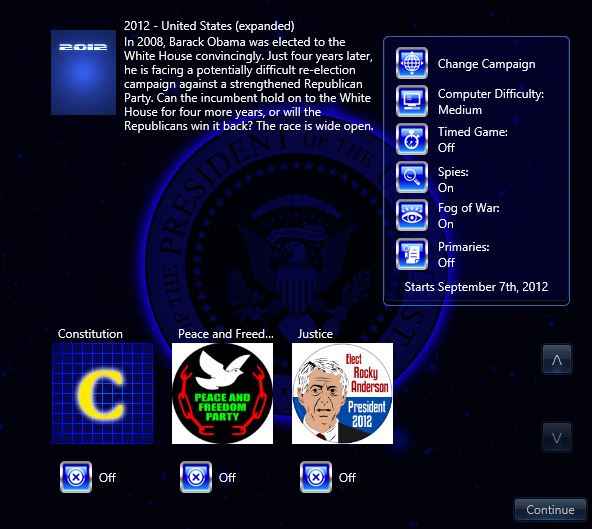
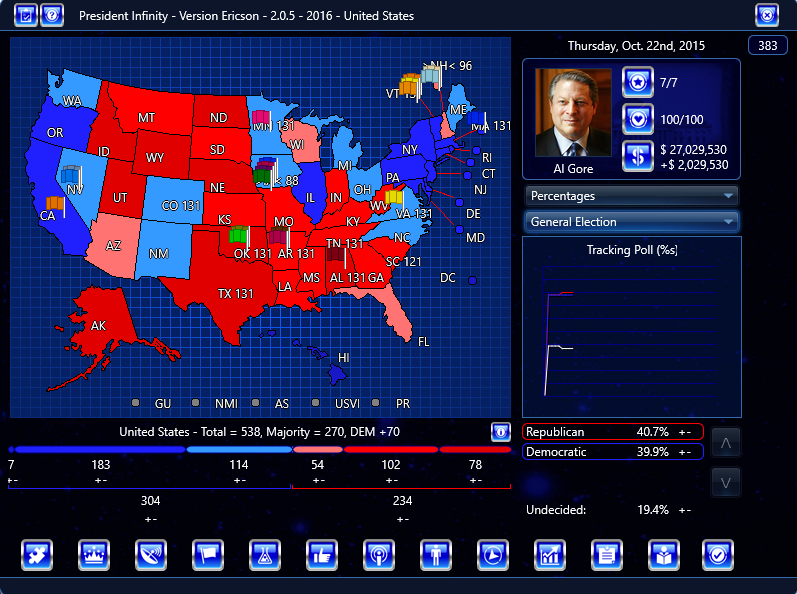
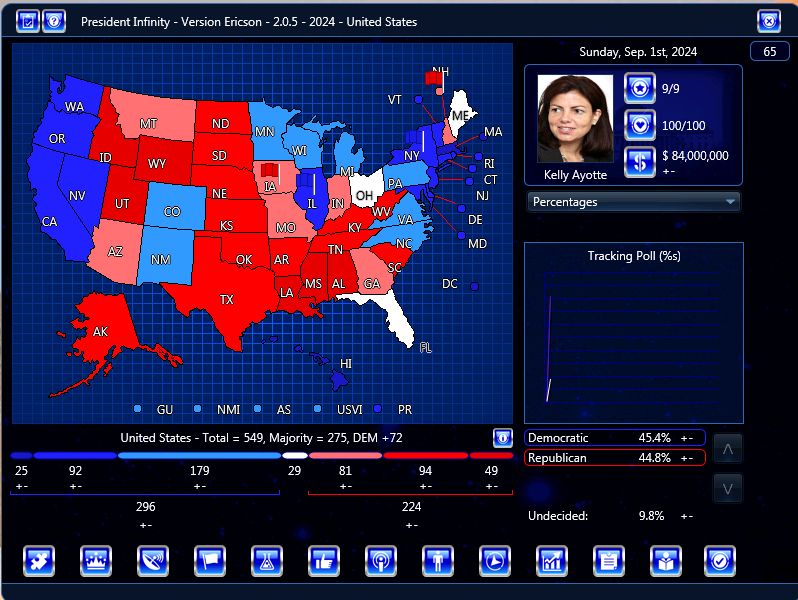
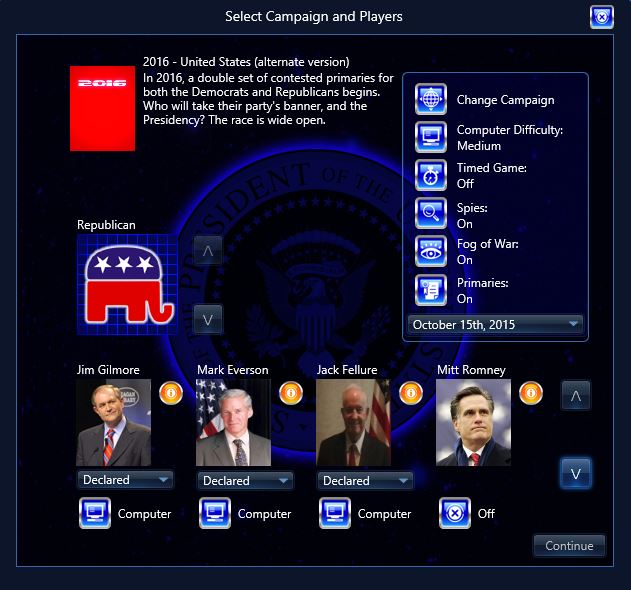
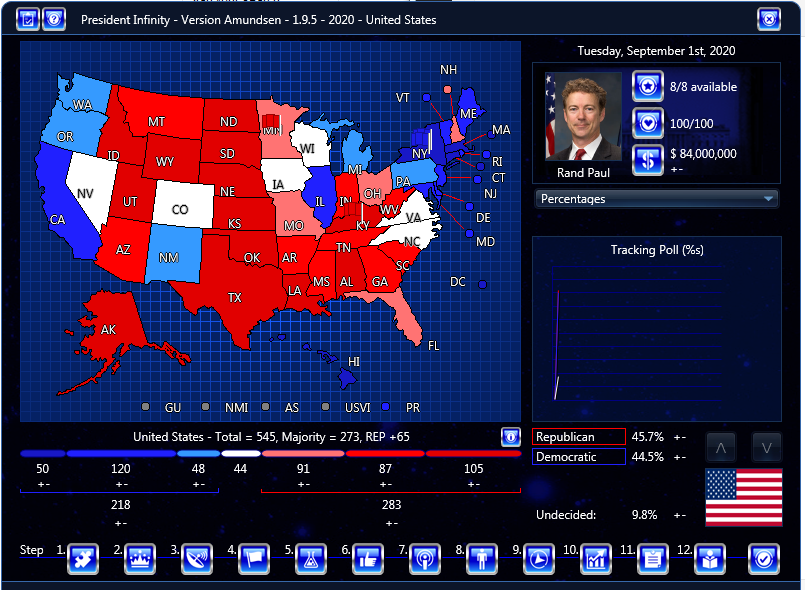
I started to make an expanded 2016 scenario. I added all minor parties and independents mentioned on Wikipedia. I gave them only ballot access in their home state, because I don’t know where they will be on in the real election. But I will update my scenario when further information will be available.

United States – 2016 (alternate version)

Please support me with your feedback and of course I plan to make further expanded elections based on Wiki information.

When the map-editor will be available I plan to make other scenarios such as Gubernatorial elections as well.

Have fun,

Luki (Conservative Elector 2) 🙂

Alberta – 2015

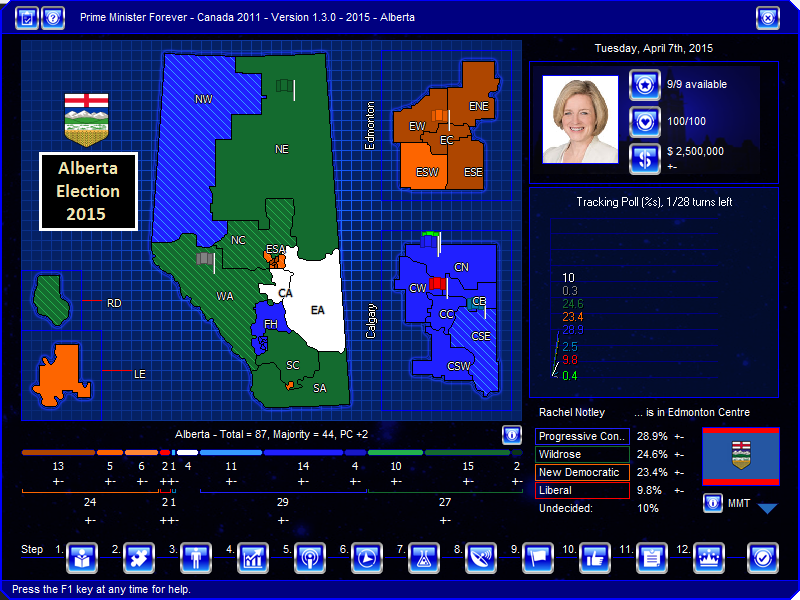
alberta2015 startup screen

Premier Jim Prentice, shortly after assuming the leadership of Alberta’s long-established Progressive Conservatives, has introduced a tough budget and called an election, gambling that he can capitalize on the seeming weakness of his rivals on both the right and the left. While most expect the PCs to win, some warn that this election might finally see the end of an Albertan political dynasty.

Designed for the PM4E2011 Canada engine. Many thanks to Patine for the municipal flags.

Link to download:
https://www.mediafire.com/?vhpa2nvq8hd9h9o

(UPDATED to include a working link.)

President Infinity 1828 Election

1828L

*This scenario was greatly updated by the Historical Scenario Commission on July 21, 2017. Version 2.0 can be downloaded here: United States – 1828 v. 2.0

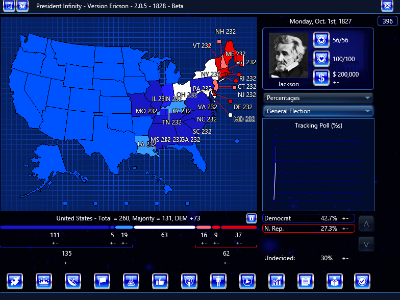
The 1828 election can be seen as Jackson’s revenge. In 1824, he had defeated the eventual winner, John Quincy Adams, in the popular vote and in the electoral college. However, with four candidates, no single candidate had enough electoral votes to be declared the winner. As such, the US House, which was dominated by Henry Clay, threw their support behind Adams after Clay’s endorsement, handing the election to the Mr. Adams.

Jackson feeling as if the will of the people had been defied, became the leading advocate of expanded democracy against an established elite. Heading into 1828, the popular Jackson seemed destined to defeat President Adams, whose presidency was having little success in fulfilling the Adams modernizing agenda.

The National Republican Party was formed under the leadership of Adams’s Secretary of State, Henry Clay. It was composed of supporters of John Quincy Adams, known as Adams Men, and other men, mostly former Federalists, supporting rapid modernization in order to compete with the powerhouses of Europe. However, Adams, despite being possibly our greatest Secretary of State, was not a successful president. He had little trust in the people to make wise decisions for themselves and made this known. He also did not work well with congress, which resulted in his programs, which resembled an antebellum New Deal, from taking ground. Had Adams been successful, and if Adams won a second term, our country could have been very different by 1860, with an increased industrialization, improved infrastructure, larger nationwide education system (and high literacy rate), and possibly a closer economic and mercantile rival to Britain and France, much sooner. However, the South and West saw Adams’s programs as needlessly intrusive and had little desire to compete with foreign countries or in anyway lose their strong sense of regionalism for the sake of nationalism.

Those in favor of popular democracy were known as the Democrats. This new party was constructed under the skill and leadership of New York senator Martin Van Buren, and he gladly let General Andrew Jackson become its figurehead. Before Van Buren, the idea of political parties was something that was roundly despised, even as people were active members of either the Jeffersonian Republicans or the Federalists. Van Buren was an advocate of permanent opposition, with two sharply opposing parties battle it out nationwide. The Era of Good Feelings was at an end. Head into 1828, the new Democratic Party ran Jackson unopposed.

This election does not have a third party.

This election allows for many what-if scenarios:

  • What if the unpopular president Adams faced competition from leading politicians of his own party, such as party leader Henry Clay, New Englander Daniel Webster and war hero William Henry Harrison?
  • What if the popular war hero Andrew Jackson was challenged by leading figures of the new Democratic Party? such as party architect Martin Van Buren, disgruntled VP John C. Calhoun, Old Guard Republican John Randolph (the Ron Paul of hsi day) and former 1820 front-runner, and somewhat recovered stroke victim, William H. Crawford.
  • What if the Anti-Mason Party formed four years earlier?

Feedback is desired.

[Note: The next election I make will be 1820. I fully endorse JViking’s amazing 1824 scenario, which I had the pleasure in helping him make by providing information and advice about the candidates and issues.]


President Infinity 1832 Election

1832mapL

*This scenario has been greatly updated by the Historical Scenario Commission on July 22, 2017. Version 2.0 can be downloaded here: United States – 1832 v. 2.0

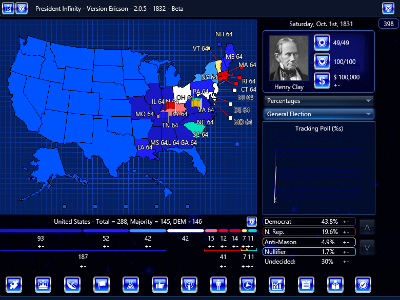
Jacksonian Democracy is all the rage. For the common man, Jackson is a godsend; for the property-owning elite, he is a demagogue. Three anti-Jackson parties emerge to stop him from winning reelection. Can three parties undo the four-year old Democratic Party, or will they merely make it much easier for the Democrats to win another four years?

The National Republicans is a new party, composed primarily of former Federalists and Adams Men (supporter of John Quincy Adams over Andrew Jackson). They hope to continue Republican values, but at a national level, hoping to blend state-lines in order to become machine that can compete with the European great powers. In this election, the unify around their leader Henry Clay.

The Democratic Party establishment supports incumbent president Andrew Jackson. He continues his war against the state banks, the elites, and against the native tribes living on the continent.

The Anti-Mason party is a mostly single-issue party of anti-Jacksonians that believe that masonic lodges are controlling the government. While they align with Jackson’s attack on elites, they have little in common with him outside of this issue. William Wirt, arguably the most influence attorney general, who had served for both Monroe and JQ Adams, is their choice for president.

The Nullifiers, or Independent Democrats, are former supporters of Andrew Jackson that feel that the president has waged a war on States’ Rights. The select John Floyd of Virginia as their presidential choice.

The election allows for many what-if scenarios:

  • What if the anti-Jackson National Republicans rallied behind former president John Quincy Adams as the strongest option to defeat Andrew Jackson?
  • What if Daniel Webster, the icon of New England, or War of 1812 hero, William Henry Harrison competed with Henry Clay for the National Republican nomination?
  • What if John C. Calhoun was the Nullifier/Independent Democrat nominee?
  • What if Northern Democrats urged the architect of the Democratic Party, Martin Van Buren, to challenge Jackson for the nomination.

Feedback is desired.

President Infinity 1836 Election

1836GEL

*This scenario has been greatly updated by the Historical Scenario Commission. Version 2.0 can be downloaded here: United States – 1836 v. 2.0

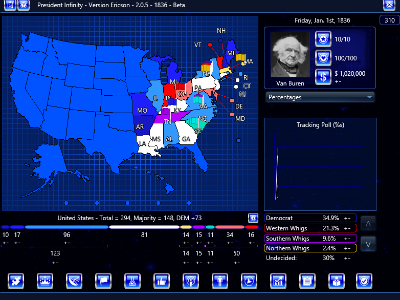
This election follows Andrew Jackson’s transformative presidency. Popular democracy, the banking system, tariffs, states’s rights are among the many issues in this election. Andrew Jackson declines a 3rd term and endorses his VP, Martin Van Buren, who had been the architect of the Democratic Party.

Note: The election does not contain a primary season.

The new Whig Party is a loose coalition of former National Republicans, Anti-Masons, Anti-Jackson’s, Adams Men, and Southern Nullifiers. As such, they are greatly disorganized, and have decided to run four candidates separately from different regions with the idea that Van Buren would get hammered in each sector by regionally popular candidates. The House would presumably select a Whig as a president in the deadlocked election, rather than selecting Van Buren. The four Whigs are General William Henry Harrison as a Western Whig, Daniel Webster as a Northern Whig, Hugh L. White as a Southern Whig and Willie P. Mangum as a Nullifier Whig.

The Democrats have unified behind Jackson’s choice of Van Buren. Jackson helped the unanimity by moving the convention so early that an opposing candidate could not be chosen.

There is no 3rd party.

This election allows for what-if scenario:

  •  What if the Whigs had unified behind a single candidate with more national range, such as Whig leader Henry Clay or former president John Quincy Adams?
  • What if John C. Calhoun ran as the Nullifier Whig?
  • What if Andrew Jackson ran for a 3rd term?

Feedback is desired.


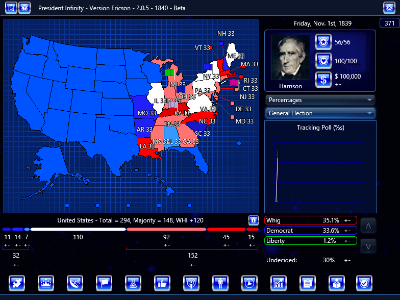
President Infinity 1840 Election

1840L

*This scenario was greatly updated by the Historical Scenario Commission on July 23, 2017. Version 2.0 can be downloaded here: United States – 1840 v. 2.0

This election takes place during the “Panic of 1837” economic depression. Economic policies under Andrew Jackson, including the removal of the national bank, are considered causes for this depression. However, as the repercussion did not occur until Van Buren’s presidency, and because Jackson was his party’s icon, the incumbent president is feeling all the heat. Van Buren, like many Democrats at the time, did not believe the federal government could constitutionally aid in helping people hurt by the economic depression. For these reasons, Van Buren and his party are not finding favor among voters going into this election.

For the Whigs, the party has decided to regroup after a blunderous campaign strategy in last election, which called for the running of four separate Whigs in the general election. This time, they’ve set their convention early with the idea of running around one of three men: General William Henry Harrison, General Winfield Scott or their party leader, Henry Clay.

For the Democrats, despite Martin Van Buren’s unpopularity, he still is the power of the Democratic Party (outside of Jackson). As such, he is the unanimous nominee in his reelection bid.

The third party is a very weak Liberty Party, which is campaigning on abolitionism.

This election allows for many what-if scenarios:

  • What if Daniel Webster tried for the Whig nomination?
  • What if the governor of New York, William H. Seward used the power of his state to win the nomination?
  • What if former president John Quincy Adams attempt a non-consecutive second term on the Whig ticket? Could his belief in government activism defeat Van Buren’s laissez faire governmental beliefs?
  • What if Van Buren had faced challengers such as James K. Polk, Lewis Cass, James Buchanan, Richard Mentor Johnson and John C. Calhoun. Could a Nullifier, such as Calhoun, or the unpopular Johnson, a slave-holder with a common law slave-wife who is the mother of his children, win the election? If Johnson won, would a slave become First Lady?
  • What if Andrew Jackson tried to save his party from defeat by running for a non-consecutive 3rd term?

Feedback desired.

Note: I thought I wouldn’t have time for another scenario before I went out of town. Obviously, I was wrong.

President Infinity 1844 Election

1844E

*The Historical Scenario Commission greatly updated this scenario on July 23, 2017. Version 2.0 can be downloaded here: United States – 1844 v. 2.0

America has Manifest Destiny on their mind, but they are divided on what party should lead it? How should Western land be acquired? Should slavery be contained or expanded? Should internal improvements link the East Coast to the West through federal aid? Who can lead America though its next epoch?

For the Whigs, the party is trying to rebound from it’s twin disaster of having nominated an aging Whig with a Whig-In-Name-Only as a VP in John Tyler. John Tyler has been kicked out of the party, and the party rallies behind their leader Henry Clay. He does not face an opponent for the nomination.

The Democrats, while supporting the former Whig incumbent president as someone closer to their own, has decided not to support him for reelection. Tyler thought of running as a 3rd party, but ultimately supported the Democratic nominee. The Democratic frontrunner is former president Martin Van Buren, who lost his reelection bid in 1840. In 1840, he was the unanimous nominee. However, in this election, he faces several prominent contenders, including expansionist Lewis Cass, moderate James Buchanan, the legal-minded Levi Woodbury, the eccentric Richard Mentor Johnson and nullifier John C. Calhoun.

The Liberty Party led by former slave-owner turned abolitionist James Birney is the 3rd party.

This election allows for many what-if scenarios:

  • What if incumbent president John Tyler ran with his proposed 3rd party, the National Democratic-Republican Party?
  • What if Henry Clay faced opposition for the Whig nomination by prominent and popular Whig figures, such as Daniel Webster, Gen. Winfield Scott, John M. Clayton, Judge John McLean, William Seward and the ancient former president John Quincy Adams?

Feedback is desired.

Note: I’ll be away for a week, so 1840 may not appear until after Jan 20th.


President Infinity 1848 Election

1848ElectionA

*This scenario was updated greatly by the Historical Scenario Commission on July 27, 2017. Version 2.0 can be downloaded here: United States – 1848 v. 2.0

This election follows the Mexican War, which helped secure our “Manifest Destiny,” but also intensified the rivalry between Free States and Slave States. Can the country unite behind a single president?

For the Whigs, their leader Henry Clay maintains his prominence; however, many are considering another person as a more electable candidate. As such, they promote two war heroes of the recent military engagement: Zachary Taylor and Winfield Scott. Daniel Webster, the leader of New England Whigs, maintains control of his region. John Clayton and John McLean are other prominent Whigs hoping to beat out the two inexperienced military

For the Democrats, James K. Polk fulfills his promise of not seeking a second term. With the acquisition of new territory, Lewis Cass, the land expansionist, is the front runner.  However, James Buchanan, Levi Woodbury and John C. Calhoun challenge him for the nomination.

A relatively strong third party exists under the Free Soil Party, composed of an alliance between liberal Northern Democrats and abolitionists. Former president Martin Van Buren, who was unable to gain any influence into the conservative-dominated Democratic National Convention, has emerged as the front runner of this third party. The irony is that Van Buren was the grand architect of the party he abandoned. He is challenged in this nomination by three prominent abolitionists: John P. Hale, Joshua Giddings and Charles Francis Adams, the son and grandson of the previous Adams presidents.

This election allows for many what-if scenarios:

  • What if rising Northern Whig, former governor William H. Seward ran?
  • What if 1st-term US Rep for Illinois, Abraham Lincoln ran at age 39?
  • What if Martin Van Buren had not left the Democratic Party and fought for delegates in the convention?
  • What if James K. Polk broke his promise and ran for a 2nd term?
  • What if former senator Franklin Pierce ran for president after having just served in the Mexican War?
  • What if the single-issue Liberty Party ran, rather than having joined the Free Soil Party?

Feedback is desired.

President Infinity 1852 Election

1852EC

*This scenario was updated greatly by the Historical Scenario Commission on July 27, 2017. Version 2.0 can be downloaded here: United States – 1852 v. 2.0

This election takes place two years after the Great Compromise, which delayed the Civil War by ten years. At the time, many thought it could achieve a permanent fix; however, taken by president from 1852-1860 quickly undid this legislation. The three great senators of the 19th century, Henry Clay, Daniel Webster and John C. Calhoun, all worked to keep the union together by advocating this legislation. Each took a hit to their reputation for their bipartisanship. Stephen A. Douglas, one of Lincoln’s rivals, played an important part by organizing the Compromise in a way that would allow it to pass.

Unfortunately, the 1852 election was a dawning of a new age. Calhoun had recently died, Clay would be dead mid-year, and Webster towards the end of the year. A new generation of politicians was emerging. Another recent death was that of President Zachary Taylor, who said he would not sign the compromise and then would go to war with any state that seceded. After Taylor’s death, Millard Fillmore signed the document. Despite Fillmore coming together with Congress, he is unable to win over people within his own party or voters to the Whig banner. The election looks to be a shoe-in for the Democrats.

For the Whigs, with Fillmore loosing support for reelection, the Whig Party turns once again to a hero of the Mexican War. This time it is Winfield Scott, arguably the most impressive general in US history, when considering his successes. At 6’5″ and nearing 300 lbs, he would be the largest president if elected. However, he lacks polish as a politician. Another challenger is the ailing Daniel Webster, who is strong only in his New England stronghold.

The Democrats have two front-runner, the expansionist Lewis Cass, whow as the nominee in 1848, and James Buchanan, who is favored in the South and in Pennsylvania. William Marcy, Stephen A. Douglas and Sam Houston are also candidates. Deep in the shadow is Franklin Pierce, who hopes to emerge as a compromise candidate that is suitable to Southerners, expansionists and Northerners.

The Free Soil Party, led by John P. Hale, is the party for abolitionists.

The election allows for many what-if scenarios:

  • What if the rising Whig William H. Seward ran?
  • What if a well-known compromisor, John J. Crittenden, ran for the Whig ticket?
  • What if former Rep. Abraham Lincoln ran before he developed a name for himself as an orator?

Feedback is desired. The costs for barnstorming, etc appears to be off. If anyone can help me figure out the best dollar level for the campaign actions, then it would be helpful. Thanks.

President Infinity 1856 Election

1856ECL

*This scenario was updated greatly by the Historical Scenario Commission on July 27, 2017. Version 2.0 can be downloaded here: United States – 1856 v. 2.0

This election takes place amid violence between pro-slavery supporters and abolitionists in Kansas. The slavery questions and sectionalism threaten to tear the country apart. However, the Democratic Party, despite threatening to split apart, has the luxury of campaigning against two weaker parties, despite a poor first term by incumbent president Franklin Pierce. A new party, the Republicans are quickly emerging as the opposition party, with former Conscious Whigs, Free Soil Democrats and Northern abolitionists joining together. The majority of Whigs, and Cotton Whigs that do not join the Democrats, unify around the American (or Know Nothing) Party, which aims at preserving the Union and keeping Catholic Immigrants, such as the Irish, Italians and Southern Germans, out of the country. While a rising party during the mid-terms, their anti-immigrant stance is hurting their reputation, causing many of their numbers to join the Republicans, which started out as a single-issue anti-slavery 3rd party during the midterms.

For Republicans, the primary leaders of the party have decided to sit the first election out, perhaps because the election looks like a lost cost. As such, they unify behind the celebrated explorer John C. Fremont, known as “The Great Pathfinder.” His only challenger is former Jacksonian Democrat, and now moderate Republican, Supreme Court Justice John McLean.

The Democrats have 4 major candidates running for the election. Ambassador and former Secretary of State, James Buchanan, who nearly won in 1852, is the front runner against incumbent president Franklin Pierce, who appears to be a defeated president. Stephen A. Douglas, the advocate of Popular Sovereignty, hopes to win over voters in the West and North to secure the election. Lewis Cass, the leader of the expansionists, while a former nominee, may be past his prime.

The American/Know Nothing Party fields former Whig president Millard Fillmore and anti-immigrant businessman George Law. Fillmore hopes that his historic signing of the Great Compromise of 1850 will unify the country behind a compromise candidate.

This election allows for many what-if scenarios:

  • What if other leading Republicans aimed for the nomination? These include Republican leader William H. Seward, former US Rep Abraham Lincoln, Speaker Nathaniel P. Banks, abolitionist Charles Sumner.
  • What if Jefferson Davis ran as a Southern option for president and William L. Marcy ran as an option from electoral-vote-heavy New York state?
  • What if The Liberty Party ran a candidate in 1856 [Note: left this party more as a way to simulate an election without selecting a competing party.]

Feedback is desired.