2020 Presidential Election

2020 Presidential Election [VCCzar version]

[This election was updated by the Historical Scenario Commission on Nov 29, 2017. It was updated again on February 4, 2018, and it can be downloaded here: United States – 2020-Feb4th2018

Backstory

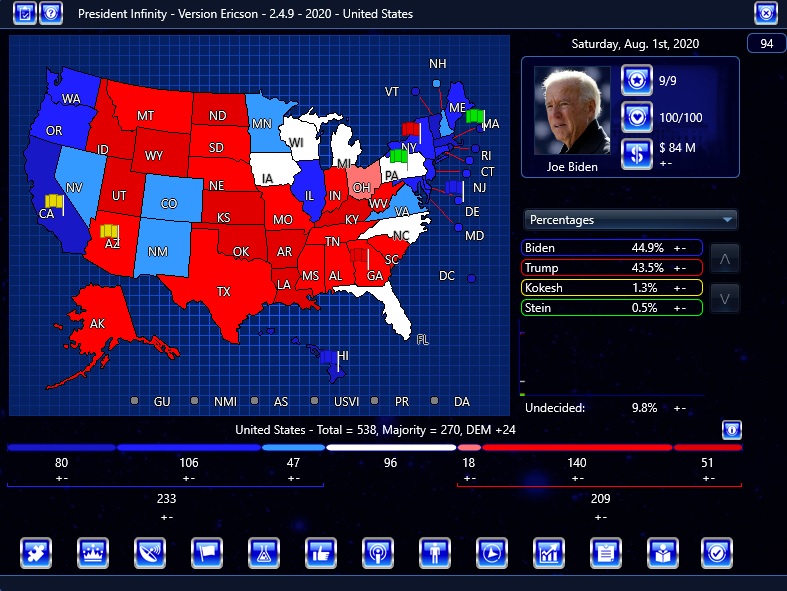
It is July 2019, and President Trump’s approval rating has never been above 40% in the average poll.

Donald Trump’s presidency has proven to be as controversial as his 2016 campaign. While his Midwestern base is exceptionally happy, he has alienated many Republicans, mostly with his unique presidential style, but also with his connection to scandalous figures from the Russian probe and some of his policies. Republicans are mostly against impeaching Trump.

Meanwhile, Democrats struggle between reformist establishment figures and populist progressives leading the party, but they have managed to narrowly retake the Senate and the House. As such, impeachment seems likely as more evidence comes in from the Russia probe.

Both parties continue to struggle with making their voters happy, while maintaining the stability and order that the establishment of both parties think is required for American supremacy.
 

bidengeneral

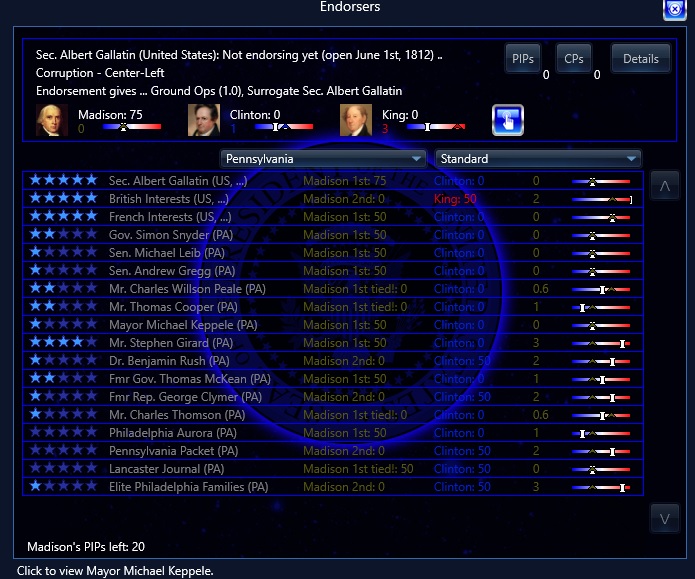
President Infinity 1812 Election

1812 US Election
*This scenario was greatly updated by the Historical Scenario Commission on July 18, 2017 and on February 1, 2018. Version 3.0 can be downloaded here: United States – 1812 Final

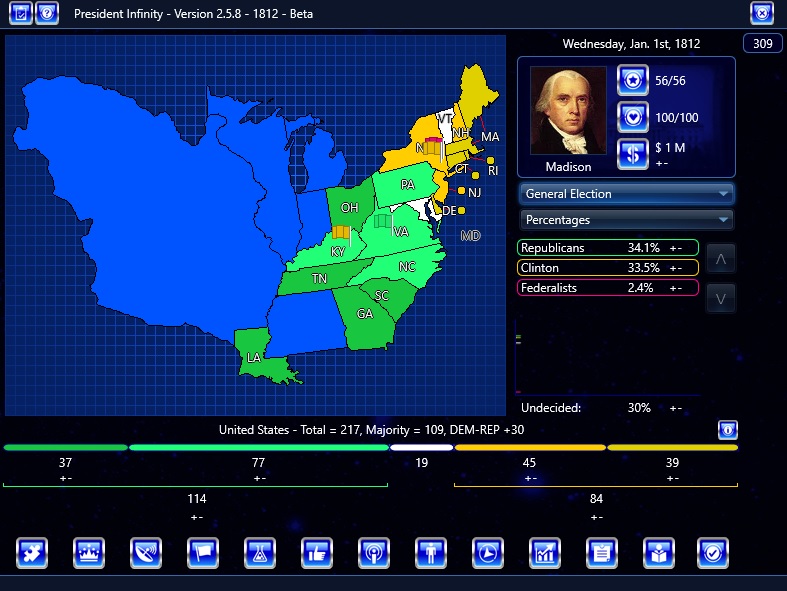
Background:This election takes place as the War Hawks in Congress inevitably push James Madison to war against the British.While the nation has a cause for war, the military is not much more prepared than it was during the Revolution. However, militant optimists expect a resounding victory, including the potential annexation of Canada.

This leads to another disagreement. Pro-war Northerners are wishing for Canada to become a new state, while Pro-war Southerners fear that a Canadian state will greatly diminish the influence of the South.Therefore, Southern politicians hope to use Canada only as a bargaining chip in a peace treaty.

Support for the war is minimal in the North, as trade is heavily dependent on British cooperation.After having endured Jefferson’s embargo,and having to deal with a continued embargo with Madison,a war with a European power would certainly wreck their economy.

Overall, Madison’s reelection isn’t guaranteed, as it had been for Jefferson. For two years, Madison was aimless, and ultimately appeared to continue Jefferson’s less popular policies, such as creating his own embargo. Madison also killed the National Bank,which worried some of the major cities.

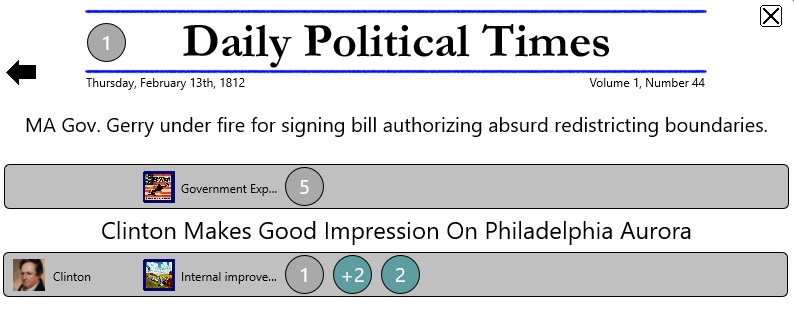
With Madison’s reelection in question, the opposition felt a chance for victory. However, the Federalists were so disorganized on the National-level following recent defeats, that most of them would accept a moderate Republican, such as DeWitt Clinton, who favors many Federalist policies,such as Federally-funded internal improvement. Some Federalists, like Rufus King, who to build a straight Federalist ticket.

What Really Happened?

The election was fairly close, but Clinton was unable to pick up the crucial state of Pennsylvania, which he needed to win the election. Had Clinton selected a Republican Pennsylvania running mate, rather than a Federalist Pennsylvania running mate, he might have won the election, even if he lost some Federalist support. Surprisingly, Madison won Vermont, despite Northern opposition to the war. Madison had solid support in the South and West.

Madison was able to win reelection despite several military setbacks during the war.
This election includes the following candidates:
ON Republicans:
Pres. James Madison, the incumbent running for reelection.
OFF Republicans 
Sec. of State James Monroe
Sec of War William Crawford
Gov. Daniel Tompkins of NY
Gov. Simon Snyder of PA
Gen. Andrew Jackson
VP George Clinton
Rep. John Randolph
Gen. William Henry Harrison
Amb. John Quincy Adams
Fmr Pres. Thomas Jefferson
Speaker Henry Clay
Gov. Elbridge Gerry of MA
Fmr VP Aaron Burr
ON Independent Fusion:
Mayor DeWitt Clinton of NYC
ON Straight Federalists:
Fmr Amb. Rufus King
OFF Federalist Party (Had the party been more organized):
Fmr Amb. Rufus King
Fmr Amb. Charles Coatesworth Pinckney
Chief Justice John Marshall
Fmr Gov. John Jay
Fmr Rep. Harrison Gray Otis
Fmr Sec. Alexander Hamilton
Fmr Pres. John Adams
Feedback is desired.

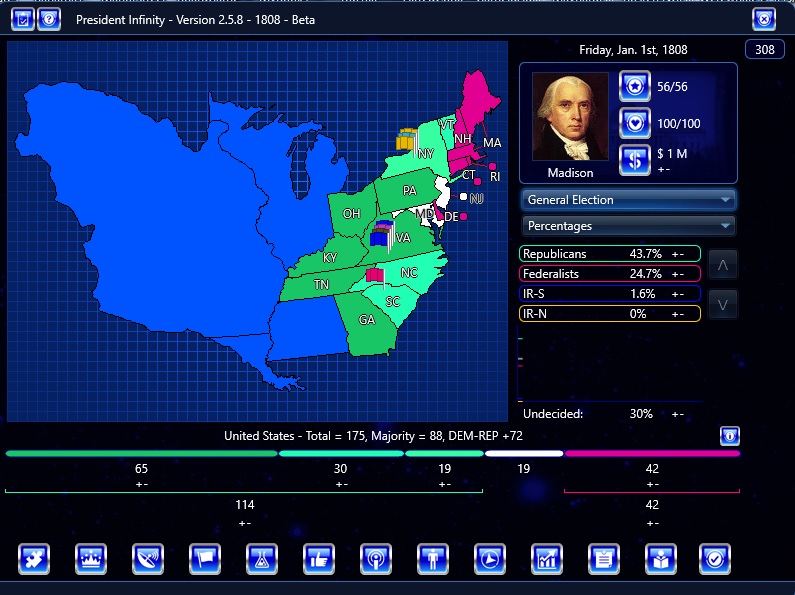
President Infinity 1808 Election


*The Historical Scenario Commission greatly updated this scenario on July 17, 2017 and January 6, 2018. Version 3.0 can be found here: United States – 1808 Final

Background:

This election takes place as Thomas Jefferson’s second term is winding down. While Jefferson’s first term was wildly popular, his decision to unleash an embargo against Great Britain has crippled Northern industry, upsetting even Northern Republicans. Despite this, Jefferson’s popularity is still high, but he has chosen to retire, rather than seek a 3rd term.

As such, Jefferson’s Secretary of State, James Madison, moves to the front rank as Jefferson’s preferred successor. Yet, Madison hasn’t the charisma that Jefferson had and, therefore, seems potentially vulnerable. Therefore, conservative Republicans led by John Randolph, who believe Jefferson and Madison are too moderate, promote James Monroe for the nomination. Meanwhile, Northern Republicans push for George Clinton’s nomination, as they tired and feared a continued Virginia Dynasty.
Federalists also sensing an out-side chance of victory, debated on whether to support Clinton’s nomination or to field one of their own candidates. Ultimately, they chose their own candidate. As Federalist leaders couldn’t convince any of their superstar politicians to run, such as Chief Justice John Marshall, they opted to support the same ticket as in 1804, Charles Coatesworth Pinckney and Rufus King.
Internationally, the Napoleonic Wars dominate the headlines.

What Really Happened?

After some tension, James Madison was able to wrap up his nomination for president rather convincingly, thanks to the endorsement of Thomas Jefferson and the Nominating Caucus. Madison kept Jefferson’s VP, George Clinton. However, groups of Never Madisons supported either VP Clinton or Monroe through election day.

Madison easily defeated Pinckney for the presidency, even taking Vermont. Yet, it could have gone another direction. Clinton supporters made headway in NY, and could have possibly held the state. A stronger Federalist candidate would have captured all of New England, plus Delaware. John Marshall, a popular Southern Federalist, would have likely to Maryland, New Jersey, North Carolina. Pennsylvania might have been a contest. In short, fear of defeat held back a chance of victory in what could have been a more contested election.
Need a Suggestion as to who to play as? Try an win as these candidates:
  • Why not test your skill by attempting to defeat James Madison with Charles Coatesworth Pinckney?
  • What if George Clinton had taken the nomination for himself and his Northern Republicans?
  • What if James Monroe had won the nomination for himself and his conservative Old Republicans?
  • What if Thomas Jefferson had run for a 3rd term?
  • What if Aaron Burr opted to run, despite crippling scandals?
  • What if Elbridge Gerry, a rare Massachusetts Republican, ran?
  • What if DeWitt Clinton ran a stronger independent Northern Republican insurgency campaign?
  • What if John Randolph personally ran a strong insurgent Old Republican campaign for his conservatives?
  • What if Chief Justice John Marshall had agreed to run as a superstar Federalist candidate?
  • What if former president John Adams sought a non-consecutive second term?
  • What if Alexander Hamilton had not been mortally wounded and ran in 1808?
  • What if John Jay opted to be the Federalist superstar candidate?
  • What if John Quincy Adams, the moderate son of John Adams, ran as a candidate that could potentially win Northern Republicans and Federalists?
  • What if Rufus King were on the top of the ticket, rather than as the VP nominee?

Feedback is desired.

1994 – House of Representatives (V.2)

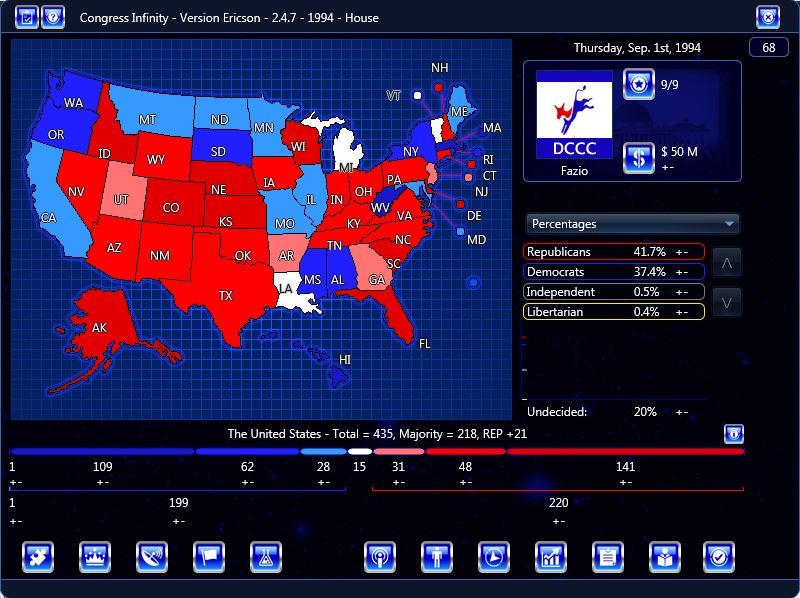
1994 saw the Republicans gain control of the House for the first time since 1952. You now have the chance to change history or inflict a worse defeat for the Democrats. This has been built with the issues ported from vcczar’s 1996 Presidential election scenario
Whats included;

  • Republican, Democrat and Libertarian candidates, the top performing ‘Independent’ in each seat. Green Party, US Taxpayer’s Party, Right to Life, Natural Law, Peace and Freedom and NY Conservative.
  • Official result as starting polls
  • Candidate strengths (4 for speaker/chief whip, 3 for incumbents, 2 for main challengers, 1 for other minor challengers)
  • Issues ported from vcczar’s 1996 Presidential election scenario
  • Surrogates
  • State Turnout Rates

1994 – House Update (19-04-18)

1994 – House (Old Version)

President Infinity 1804 Election


US Election 1804

*The Historical Scenario Commission greatly updated this scenario on July 17, 2017 and on December 31, 2017. Version 3.0 can be downloaded here: United States – 1804 Final

Background:

The 1804 election took place during a brief hiatus in the French Revolutionary War abroad, resulting in booming international trade. Additionally, Thomas Jefferson’s decision to buy Louisiana Territory from Napoleon opened cheap land out West for settlers. As such, Jefferson’s popularity was arguably at its peak. Therefore, Jefferson’s renomination and reelection was virtually assured.

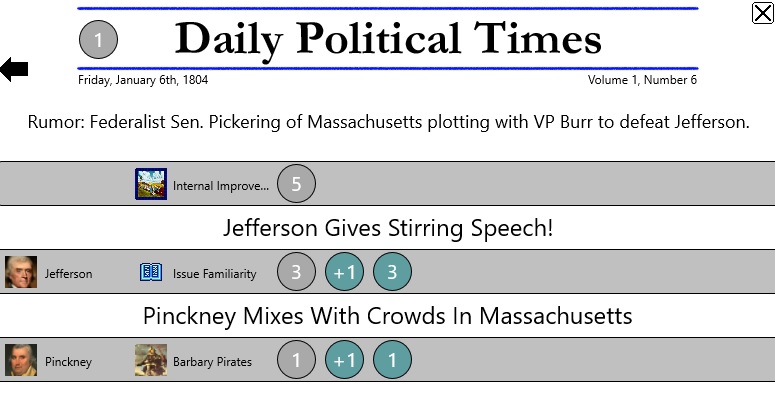
Meanwhile, Federalists were in disarray with only New England and New York having any semblance of an organized party. New England Federalists so opposed Jefferson that many of them, led by Sen. Timothy Pickering, hatched a plan to work with VP Aaron Burr to secede from the country if Jefferson won reelection. However, many notable Federalists, including Alexander Hamilton, opposed the scheme.
What Really Happened?
 
Thomas Jefferson sought reelection without contest from his party. Federalists were unable to convince any sort of superstar from running; therefore, they settled for last election’s VP-nominee, Charles Coatesworth Pinckney, whom they thought would father Southern support.
Meanwhile, the Northern secessionist plot failed badly. Secessionists banked on incumbent VP Aaron Burr winning the gubernatorial election in NY, and hoped that Burr would then align with New England and break off from Jeffersonian America. However, Alexander Hamilton thwarted both Burr and his fellow Federalists by working against the scheme and Burr’s election. Ultimately, Burr and Hamilton agreed to a duel over a lifetime of grievances against one another, resulting in the mortal wounding of Alexander Hamilton. Rumors of Burr’s dissatisfaction with Jefferson, rumors of his possible collusion in a secession plot, and his killing of Alexander Hamilton, resulted in Jefferson dropping Burr as his VP for another New Yorker, George Clinton. New England would make another secession attempt during the War of 1812, nearly a decade later.
On election day, Jefferson trounced Pinckney, 72.8% to 27.2% in the greatest popular vote landslide in a contested election. Additionally, Jefferson won four of the five New England states, including Massachusetts. Clinton helped Jefferson win New York. Only Delaware and Connecticut chose Pinckney.
Need a Suggestion as to who to play as? Try an win as these candidates:
  • Why not test your skill by attempting to defeat Thomas Jefferson with Charles Coatesworth Pinckney?
  • What if George Clinton, Aaron Burr, or Elbridge Gerry contested Jefferson’s nomination with the support of Northern Republicans?
  • What if James Madison became impatient and aimed to win the nomination for himself?
  • What if conservative Republicans had rallied behind James Monroe in 1804?
  • What if Alexander Hamilton ran for the presidency and survived his duel with Aaron Burr?
  • What if other Federalist superstars, such as John Marshall and John Jay ran?
  • What if John Adams sought a non-consecutive second term?
  • What if John Quincy Adams aimed for the presidency in 1804?
  • What if Gouverneur Morris or Henry Lee ran for the Federalists?

Feedback is desired.

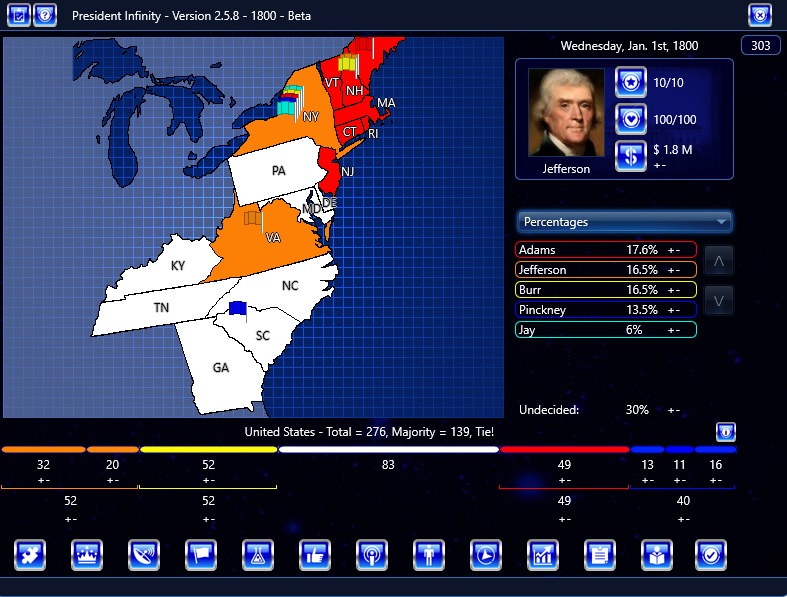
President Infinity 1800 Election


US 1800 Election

[This scenario was greatly updated by the Historical Scenario Commission on July 15, 2017 and on December 27, 2017. Download version 3.0 here: United States – 1800 Final]

Background:

This election takes place amid a time of crisis. America has been caught in the fallout of the French Revolution, and finds itself in an undeclared war with Napoleonic France, which has been meddling in American domestic affairs, and harassing American merchant fleets. President John Adams has drawn fire from both major parties for his responses to French aggression. The Jeffersonian Republicans have gathered their energy from their fierce opposition to the Alien & Sedition Acts, while the Federalists have attacked Adams’s independent streak, and his desire to achieve peace with France. As such, Jefferson and Madison work to orchestrate a Republican Revolution, while Hamiltonian Federalists secretly wish to replace Adams on the ticket.

Another foreign policy issue facing the candidates is the increased attacks by Barbary Pirates. Should the US increase it’s navy? Should the US attack the pirates with the navy they currently have?

Domestically, one of the major issues, outside of the domestic realm of the Alien & Sedition Acts, is the question of expanded suffrage. Should more states allow a popular vote? Should the government sell cheap Western property to grow the voting pool? Should those without property be allowed to vote?

Also dominating the headlines is the New York power struggle between Aaron Burr and Alexander Hamilton, as both hope to position New York for their respective parties for the 1800 election. Internationally, Napoleon dominates the news.

This election is also the last election under the old electoral system.  Electors vote on both the president and vice president, which had lead to Adams and Jefferson serving on the same ticket in 1796, despite memberships to different parties.

What really happened?

John Adams’s pessimism was well-founded. While he was able to upset Hamilton’s scheme to place Pinckney at the top of the ticket, Federalist in-fighting hampered Adams’s election chances, and while Adams restored his popularity with establishing peace with France, the news came too late to help Adams win reelection.

Jefferson’s popularity was such that his election was believed to be very certain. Despite this relative certainty, Jefferson’s allies held no punches during the campaign against Adams. Likewise, President Adams’s allies responded in kind, in what was a very nasty campaign, full of ad hominum attacks.

This election did not go smoothly. Combined attacks from Republicans and Hamilton threw Adams into a distant 3rd place in the election. Alexander Hamilton tried to convince NY Gov. John Jay to nullify the New York results when it appeared Republicans would take the state, but Jay refused.  Jefferson won in a landslide, but the supposed vice president choice, Aaron Burr, ended up with the same number of electors, as an elector had forgot to give a vote to someone else to prevent a deadlock. It was well-known that Jefferson was the lead man on the Republican ticket, but Aaron Burr did not bend. The election went to the US House.

After several tied votes, Alexander Hamilton made a surprise move by pressuring Federalists to give their Burr votes to Jefferson, who he believed had more principle, despite not being a moderate Republican like Burr. Hamilton’s influence handed the election to Jefferson, and made Burr vice president.

Need a Suggestion as to who to play as? Try an win as these candidates:

  • Can you win reelection as Pres. John Adams?
  • Can you upset Thomas Jefferson as Aaron Burr, winning the presidency from under the presumed winner’s feet?
  • Can you fulfill Hamilton’s plan to land the presidency to Charles Coatesworth Pinckney?
  • Can you secure a dark horse victory with John Jay?
  • What if Alexander Hamilton tried to take control of the party from John Adams by running in the election himself? Could such a controversial candidate win?
  • What if indebted Founding Father Robert Morris won in an attempt to resurrect his reputation?
  • What if Founding Father Gouverneur Morris ran as another Federalist option? Can such an elitist win with a Jeffersonian tide in the country?
  • What if Founding Father Rufus King, greatly respected by both parties, ran as a likable Federalist?
  • What if Rev War officer Henry “Light Horse” Lee ran as a Southern Federalist?
  • What if an Arch Federalist, such as 41-year-old Fisher Ames, ran? Could he win outside of Massachusetts?
  • What if the 77-year old Samuel Adams make a last run for the presidency, despite failing health?
  • What if former Northern Republican superstar George Clinton of NY made another attempt at the presidency?
  • What if Founding Father Elbridge Gerry ran as a rare Massachusetts Republican?
  • What if James Madison was too impatient, and opted to run for the presidency, even with Jefferson as the favored Republican?
  • What if 41-year-old James Monroe, figurehead of the Conservative Wing of the Republicans, ran in 1800?
  • What if George Washington’s freak illness in December 1799 had not killed him, and what if Federalists pressured him to run to prevent a Republican takeover?


Feedback desired.

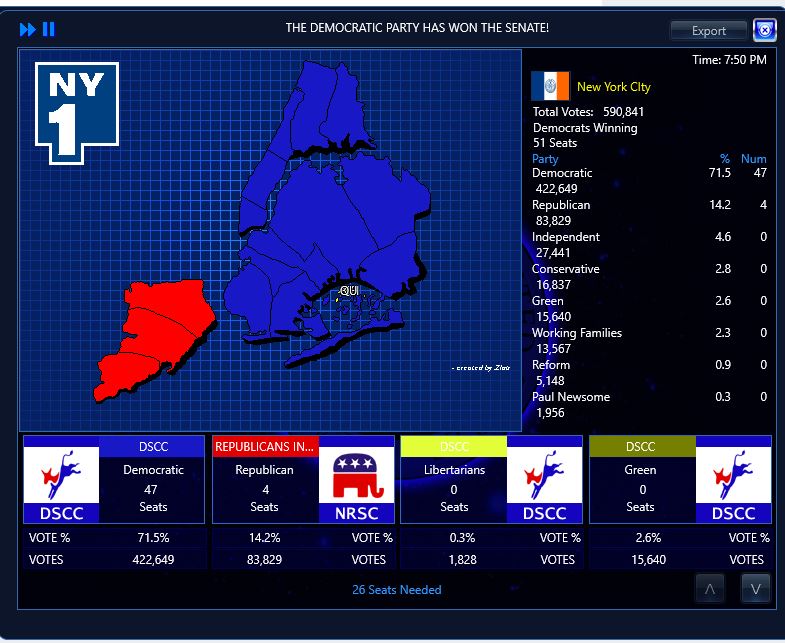
Senate – 2018

Hello all! I’ve been slowly plugging away on an alpha version of the 2018 Senate Mid-Term election. I’ve possibly over-strengthened the Democrats, and I’ve yet to add in events, but hopefully this alpha will at least pique your interest! Feel free to leave a comment or criticism of how I’ve set the whole thing up. I’ll be updating this hopefully within the week!

Senate – 2018

Done:

  • Major Party Candidates
  • Major Independents
  • Add surrogates for main parties
  • Modify issues

To Do:

  • More Independents
  • More Third Parties
  • Events
  • More Issues + Further issue tweaks

New York City Mayoral Election 12-15-17

new york city mayoral 2017 update 12-15-17

This is an update to my original NYC Mayoral Election scenario. Changes include:

  • Starting percentages equal to real-life results
  • Malliotakis moved to top of Republican listing of candidates
  • Richard Bashner added as “on” candidate
  • Robert Gangi added as “on” candidate
  • Michael Tolkin added as “on” candidate
  • Don Peebles turned “off”
  • All Republicans turned “off” except Malliotakis and Massey
  • Parties reordered
  • Turnout adjusted
  • Aaron Commey added as Libertarian nominee
  • Michael Tolkin added as independent
  • Sal Albanese added as Reform nominee
  • Independent parties renamed to Mayoral Lines
  • Primary percentages adjusted
  • Adjusted money coefficient
  • Removed Reform Party endorser
  • Modified primary delegates and turnout