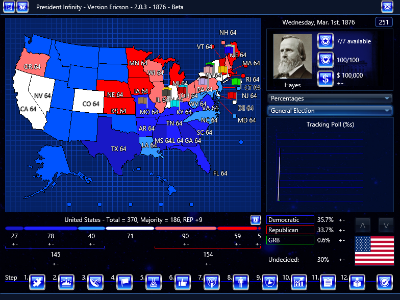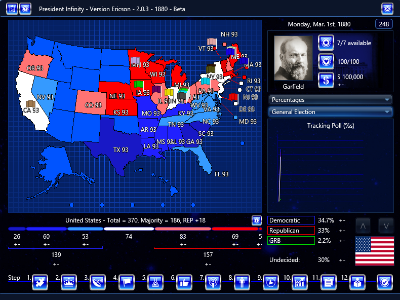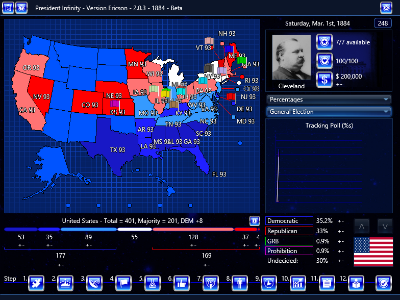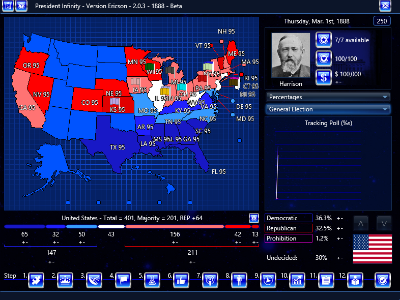
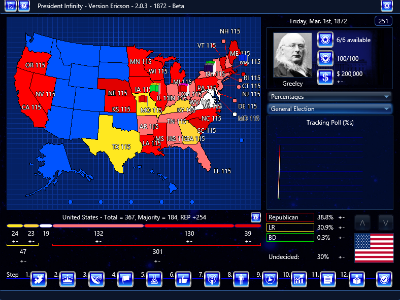
President Infinity 1888 Election

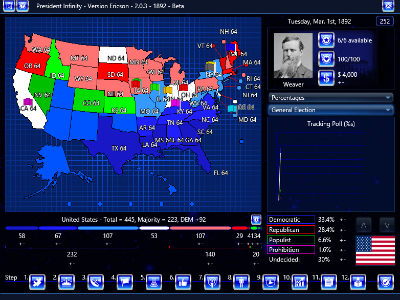
1888Election

*This scenario was greatly updated by the Historical Scenario Commission on August 21, 2017 and can be downloaded here: United States – 1888 v. 2.0

This election takes place in the Gilded Age of American history. Grover Cleveland is the incumbent president. Despite building a strong economy, his severely pro-business policies have alienated rural and labor voters. Will Cleveland’s lack of interest in leading his own party as a harmonious unit hurt him in the election or will the country’s economic success land him four more years?

For the Democrats, even the unhappy Southern and Western Democratic leaders reluctantly supported Cleveland, despite his unwillingness to compromise on his Bourbon Democratic positions.

For Republicans, the field is wide open. Front runner, and last election’s nominee, James G. Blaine, the leader of the moderate Republicans has declined to run for president. This leaves John Sherman, the brother of General William T. Sherman, as the new front runner. However, Russell Alger, Walter Gresham and many others have many supporters. A quasi-dark horse is former senator Benjamin Harrison, the grandson of a former president.

The Prohibition Party is the 3rd party option. General Clinton Fisk was a civil war hero, civil rights activist and a prohibitionist. Can he expand the party?

The scenario allows for many what-ifs:

  • What if Grover Cleveland’s nomination was contested? Several politicians that were former Confederate generals can try to deprive Cleveland of the nomination. These include Simon Boliver Buckner, John Brown Gordon, Wade Hampton, Fitzhugh Lee and William Henry Fitzhugh Lee.
  • What if John Quincy Adams II, son of an ambassador and grandson and great-grandson of two presidents, tried to run for president? Can he gain traction outside of Massachusetts?
  • What if pro-Silver Democrat Richard Bland ran for rural voters out west?
  • What if the leader of the moderate Republicans, James G. Blaine had run. He was the presumed front runner.
  • What if Rep. William McKinley did not refuse to run?
  • Two sons of presidents were pushed to run, but did not. What if Robert Todd Lincoln and Frederick Dent Grant ran for the presidency?
  • Former slave and civil right orator Frederick Douglass received some token delegates in 1888. What if civil rights activists supported his running for president. Could he become the first African-American president?
  • The Greenback Party declined to run a candidate in 1888. What if they had run James Weaver again?

Note: endorsers will also mention if a politician was a Civil War hero for the enjoyment of Civil War buffs that might play this game. This was done in the 1892 scenario as well, and will be done in the elections between 1864-1892.

Feedback is welcome. Updates and improvements will eventually arrive.

President Infinity 1892 Election

1892GeneralElection

*This scenario was greatly updated by the Historical Scenario Commission on August 24, 2017. It can be downloaded here: United States – 1892 v. 2.0

The 1892 election takes place during the Gilded Age, when the major political topics were bimetalism, tariff reform and corruption. President Benjamin Harrison is the incumbent president; however, his first term has been somewhat unpopular among those impacted by the very high McKinley Tariff (named after the future president).

For Republicans, the establishment is rallying around President Harrison, but he faces many delegates from his party hoping to dump him in favor of other popular candidates. Former Republican nominee, and leader of the moderate Republicans, James G. Blaine is one of the “Dump Harrison” candidates, while Governor William McKinley is the favorite “Dump Harrison” nominee among more conservative Republicans.

The Democrats have their own problems. A former president, Grover Cleveland, is the favorite among the conservative and pro-gold, Bourbon Democrat faction, which supports businesses, while pro-Labor, pro-bimetalism Democrats favor Horace Boies. In addition, David B. Hill hopes to be a reform option and Adlai Stevenson is a pro-silver choice for some delegates. Two Bourbon Democrat leaders, John Carlisle and Arthur Gorman, hope to take the leadership position from Grover Cleveland.

The election has a strong third party in the Populist Party, led by James Weaver. The are pro-silver and pro-labor, and they have their support mostly in the West and in the South. Their numbers include many former Democrats and former Republicans. The Prohibition Party is the other third party in this scenario.

This election allows for many what-ifs:

  • What if former speaker of the house, Thomas Brackett Reed ran?
  • What if Abraham Lincoln’s son, Ambassador Robert Todd Lincoln, listened to his supporters and jumped into the race?
  • Senator John Sherman, the brother of General William Tecumseh Sherman, was arguably the most powerful senator at the time, giving his name to the Sherman Anti-Trust Act. Could he be the moderate Republican needed to win the election? He declined to run in real life.
  • Rep. Henry Cabot Lodge was the leading proponent for American imperialism. Can an aggressive foreign policy hawk win an election in 1892?
  • Governor Robert Pattison was a popular, moderate Democrat. Could he hold the two wings of the party together?
  • Richard P. Bland was the leading Silverite (pro-silver) Democrat in congress. Would he be able to win over Populists to the party, without losing Bourbon Democrats to the Republican Party?
  • Leonidas Polk was the front-runner for the Populist Party, but he died. What if he had lived? Could he have increased the party’s fortunes?

Feedback is desired. Updates will be forthcoming.

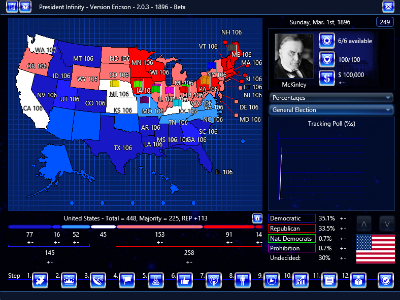
President Infinity 1896 Election

1896GeneralElection

*This election was greatly updated by the Historical Scenario Commission on August 24, 2017. It can be downloaded here: United States – 1896 v. 2.0

The 1896 election focused primarily on the Panic of 1893 financial crises. Unemployment was high and the economy was shaky. The incumbent Bourbon Democrat (Fiscally conservative, pro-Gold Standard) president, Grover Cleveland, decided not to run for a 3rd term, partially because he was becoming increasingly unpopular in the West and much of the South. The argument for improving the economic welfare of the people centered on silver and gold. Bourbon Democrats and mainstream Republicans, both conservatives, wanted a Gold Standard. Moderate Republicans and mainstream Democrats wanted both gold and silver to back currency (bimetallism). Populist Democrats and Republicans advocated Free Silver, as the believed silver, rather than gold, would increase their standard of living. All other issues were of secondary importance.

For Republicans, the mainstream element flocked to the popular and respected William McKinley of Ohio. However, he faced some competition from powerful Speaker of the House Thomas Bracket Reed, Pennsylvania party boss Matthew Quay, former Vice President Levi P. Morton and respected Senator William B. Allison. They embraced the Gold Standard. As such, many Silver Republicans voted Democrat.

The Democrats, rebuking President Cleveland, dropped the Gold Standard from their platform and embraced bimetallism. As such, all the nominees were pro-silver candidates. Richard “Silver Dick” Bland had a long history of promoting silver and was the favorite. However, 36-year-old William Jennings Bryan was the rising star of the party, as he condemned the Gold Standard by saying,  “you shall not crucify mankind upon a cross of gold.” Other leading Silverites competed. Overall, a fairly competitive convention. Gold Democrats either voted for McKinley or voted for the 3rd Party National Democrats.

This election has two third parties, both which were primarily single issue. The National Democrats tried to split the Democratic Party to prevent the Democratic silver platform. Their ticket included to ancient politicians: John Palmer and former Confederate General Simon Boliver Buckner, both in their 70s. The Prohibition Party aimed at passing prohibition laws.

The election allows for several what-ifs:

  • What if former Republican president Benjamin Harrison ran for a non-consecutive second term? He left office unpopular, but with silver back on the table, could a silver-tolerant Republican with presidential experience get back in the office?
  • As usual, Robert Todd Lincoln, the son of our great president, was pushed to run. What if he had?
  • Henry Cabot Lodge of Massachusetts was the leader American Imperialist in the Senate, advocating expanding America’s military might and possessions. He was a mentor for Teddy Roosevelt and other politicians greatly in favor for war with Spain and the acquisition of territories outside the United States. What if he had run?
  •  What if Grover Cleveland ran for a 3rd term? He would have received every Gold Democrat vote, but could he convince Silver Democrats that voting for him was the best bet to beat Republicans?
  • What if Grover Cleveland had accepted the National Democrat nomination? Would a sitting president rebuke his own silver-happy party and run as a 3rd party for the proponents of gold? Can Cleveland do more than just split the Democratic vote?

Feedback is desired to improve the scenario.

President Infinity 1900 Election

1900GeneralElection

*This scenario was greatly updated by the Historical Scenario Commission on August 28, 2017. It can be downloaded here: United States – 1900 v. 2.0

The 1900 election was a rematch between William McKinley and pro-labor, pro-silver Democrat, William Jennings Bryan. Both nominees were virtually unopposed. McKinley’s reelection seemed pretty much assured as the economy was strong and he had just won the Spanish-American War.

The election allows for some what-if scenarios so that these candidates face some competition:

  • What if Governor Theodore Roosevelt attempted a premature run for president?
  • What if leading progressive Republican, Robert La Follette ran against McKinley?
  • What if wealthy, pro-labor publisher, William Randolph Hughes, ran for president?
  • What if Grover Cleveland, the pro-business, pro-Gold Standard former president ran for a 3rd non-consecutive term?
  • Admiral George Dewey, a hero of the recent war, wanted to run for president, but the media slammed him for his gaffes and his obvious political naivety.

Feedback to improve the scenario is desired.

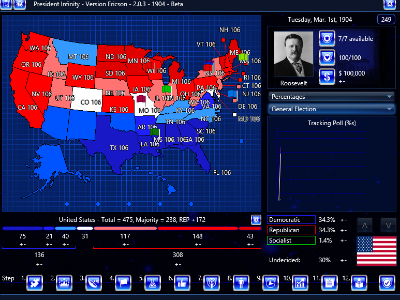
President Infinity 1904 Election

1904election

*This scenario was greatly updated by the Historical Scenario Commission on August 28, 2017. It can be downloaded here: United States – 1904 v. 2.0

Theodore Roosevelt has finished most of slain president William McKinley’s term. And now he hopes to win election in his own right. Roosevelt’s presidency has been both peaceful and active. However, not everyone is happy. Democrats claim he is using too much executive power. While in his own party, conservative Republicans feel he is becoming too Progressive. A Drop Roosevelt movement was launched by conservatives under Roosevelt’s former campaign manager Mark Hanna, but Hanna died early in the election season. Now, Roosevelt runs unopposed and seems unstoppable. This election takes place in the Progressive Age.

As mentioned above, Roosevelt run unopposed.

For Democrats, two-time nominee and leader of the pro-labor wing of the party, William Jennings Bryan has decided not to run again. For pro-business (Bourbon Democrats), former president Grover Cleveland has ignored calls to run for the presidency again. Not a single major politician among the Democrats has decided to take on President Roosevelt. This leaves the field wide open. By default, the labor-wing rallies behind the wealthy publisher William Randolph Hughes. Bourbon Democrats flock to the front runner New York judge Alton B. Parker. Several other figures seek to become alternatives to these two men.

The Socialist Party is the 3rd party in this election with Eugene Debs as the nominee.

This scenario allows for several what-ifs:

  • What if former Democratic nominee William Jennings Bryan ran for a 3rd time?
  • What if former president Grover Cleveland went for a 3rd non-consecutive term in office?
  • What if the former commanding general of the United States, Nelson A. Miles, listened to the calls to run for the presidency?
  • What if Mark Hanna had not suddenly died and stood as the conservative option for Republicans?
  • Former Hanna backers urged Charles Fairbanks to run. What if he had?
  • Governor-general of the Philippines, William Howard Taft, was pushed by moderates to take on his friend, Theodore Roosevelt. What if he had?
  • What if Robert La Follette had led Progressive Republicans in 1904?

Feedback to improve the scenario is desired.


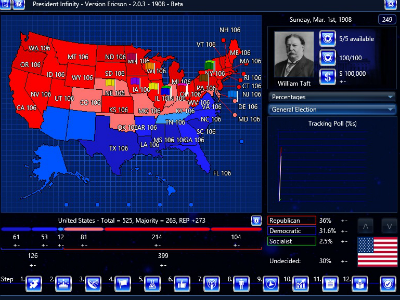
President Infinity 1908 Election

1908Election

*This scenario was greatly updated by the Historical Scenario Commission on August 29, 2017. It can be downloaded here: United States – 1908 v. 2.0

Theodore Roosevelt fulfills his promise to not run for a 3rd term. Roosevelt proved to be the most powerful president up to that time. The 1908 election takes place in an increasingly progressive era. Which candidate is the best to lead the nation after Roosevelt? The president’s handpicked successor is Taft, who seems nearly unstoppable in both the primaries and the general election.

For the Republicans, as mentioned above, Taft is the clear front-runner. However, he faces challenges from both the left and the right. Robert La Follette is the progressive icon of the party and hopes to improve upon Roosevelt’s progressive actions. Philander Knox is the favorite among more conservative Republicans. Other major candidates are the moderate conservative Charles Evans Hughes, Speaker Joseph Cannon, VP Charles Fairbanks, and a few favorite son candidates.

The Democrats are attempting to recover from a crushing defeat in 1904, when they nominated a conservative, pro-business (Bourbon Democrat) nominee, Alton B. Parker. They have now turned their eyes towards their two-time nominee, William Jennnings Bryan, the leader of the populist, progressive wing of the Democratic party. His only challengers come from two more moderate Democrats, George Gray and John A. Johnson.

Eugene Debs leads the Socialist Party.

This election allows for many what-if scenarios:

  • What if Theodore Roosevelt broke his promise and ran for a 3rd term?
  • What if Elihu Root, the brilliant cabinet member under Roosevelt, ran for the presidency?
  • William Randolph Hearst was a pro-labor Democrat and the most powerful publishers in America. He would make an attractive alternative to Bryan among populists. What if he ran?
  • What if the 1904 nominee, Alton B. Parker, tried to win with his Bourbon Democrat platform?
  • What if Woodrow Wilson attempted to run for the presidency four years earlier? Can he win without gubernatorial experience?

Feedback and suggestions are desired to fix my errors and to make the game more enjoyable.

President Infinity 1956 Election

1956GeneralElection

*This scenario has been greatly updated by the Historical Scenario Commission on October 8, 1956: United States – 1956 v.2.0

Eisenhower’s first term has ended and his reelection seems assured. However, his health is an issue after having suffered a heart attack the previous year. Many believed he would not run for reelection; however, in 1956, he declared that he would run. This election took place during the Cold War with a post-Stalin Soviet Union.

For Republicans, Eisenhower’s late entry into the race led to a few candidates having declared an intention to run. William Knowland and John Bricker were too conservative options for voters.  S. C. Arnold and Joe Foss were favorite candidate options. However, this competition appeared to be no threat to the president.

The Democrats had a much more varied field. Adlai Stevenson was the frontrunner in his renomination bid. The populist option was once again Estes Kefauver. Former president Truman supported Averell Harriman as a compromise choice. Various favorite son candidate, including Lyndon B. Johnson, joined the election.

The top third party was a very weak States’ Rights Party.

This election allows for many what-if scenarios:

  • What if Harold Stassen once again ran as the liberal Republican option?
  • Some pushed Herbert Hoover to run, despite the near quarter century since his presidency.
  • Douglas MacArthur was still considered a candidate even though he was in his mid-70s.
  • Henry Cabot Lodge was arguably the leader of the Eastern moderate establishment. What if he ran?
  • Can Prescott Bush be the first Bush president?
  • What if Harry S Truman attempted a comeback?
  • Byrd, Kerr, Russell and Fulbright could have been Southern options for the Democrats.
  • Franklin D. Roosevelt, Jr. had some supporters among those nostalgic for the FDR presidency. What if he had run?
  • John F. Kennedy was a VP option in 1956. What if he had run for the presidency?

Feedback, along with any suggestions to remedy any problems, is desired.

Australia – 1975

Australia 1975

A series of controversial decisions has culminated in Governor-General John Kerr’s dismissal of Prime Minister Gough Whitlam nad his appointment of Malcolm Fraser, who did not have a lower house majority, in his place. Though Whitlam’s supporters are furious, many voters are more concerned about his turbulent handling of the economy.

Playable parties are Liberal, Labor, National Country, Democratic Labor, and Independent – no alternate leaders as of now. I am more than happy to hear feedback and consider further changes!

Australia – 1975

President Infinity 1952 Election (version 2.0)

1952Elections

Version 2.0 (w/ events added by Davis Os)

*This scenario has been greatly updated by the Historical Scenario Commission on October 8, 2017 and it can be downloaded here: United States – 1952 v.2.0

America is in the midst of a Cold War with the Soviet Union abroad, and in the middle of the Red Scare domestically. Which party can promise the greatest defense against the fear of Communism?

The Republicans have not won a presidential election in 24 years. The Republican moderate Eastern establishment, including two-time nominee Thomas Dewey, have decided to endorse World War II hero, Dwight D. Eisenhower, as he promises to be the best bet to bring the Republicans back to the White House. However, the aging Robert Taft realizes this is his last chance to win the White House for his conservative wing. Harold Stassen once again hopes to be the liberal option; however, he will have to share influence with Earl Warren. General Douglas MacArthur is also running; however, unofficially.

The Democratic party is collapsing around the unpopular incumbent president Harry S Truman. He would eventually refuse a 3rd term, allowing for a fresh face. The front runner is the populist and liberal Southern senator from Tennessee Estes Kefauver. However, some view him slightly too radical for 1952. Two moderate options exist in Adlai Stevenson (a reluctant candidate) and Averell Harriman (who is inexperienced). The conservative Southern option is Richard Russell. Truman’s VP, Alben Barkley, hopes to be a moderate Southern compromise choice. Several favorite son candidate try to hold their state’s delegates.

The Progressive Party is the largest 3rd party led by lawyer Vincent Hallinan and his running mate, Charlotta Bass, the first African-American VP nominee.

This election has many what-if scenarios:

  • What if Thomas Dewey, the 1944 and 1948 nominee ran for the Republican ticket again?
  • What if anti-Communist Red Scare monger, Joseph McCarthy, ran for the presidency at the height of his influence?
  • Liberal Wayne Morse, Moderate Henry Cabot Lodge and Conservative Everett Dirksen and John W. Bricker were other Republican candidates with support that chose not to run. What if they Ran?
  • What if President Truman decided to run for a 3rd term?
  • What if Harry F. Byrd attempted to be the Southern option once again for the Democrats?
  • Can George C. Marshall be the war hero option for the Democrats?
  • FDR, Jr. had some backers pushing him to run to revitalize the party. What if he had agreed despite his inexperience.
  • What if billionaire Joseph P. Kennedy pushed his son, Rep. John F. Kennedy to run in 1952 in his first year of eligibility. Can a 35 year old U.S. Rep win the nomination and the White House? He would have been the strong anti-Communist option for the Democrats.
  • Eleanor Roosevelt (added by Davis Os)

Feedback, along with any suggestions to remedy any problems, is desired.

President Infinity 1948 Election

1948GeneralElection

*The Historical Scenario Commission greatly updated this scenario, and it can be downloaded here: United States – 1948 v.2.0

The end of World War II transitions into a Cold War. Domestically, the country fears Communist influence inside of the country. Internationally, the country fears the only other superpower remaining in the world: The Soviet Union. Truman also has many other problems. His popularity is very low and he faces a much more confident Republican Party, which has not held the presidency since Herbert Hoover. The president also must deal with his own party, which is breaking apart at the seams.

For the Democrats in 1948, the party establishment sticks with Truman, as he has the power of incumbency. However, a “Dump Truman” ticket is forming around the moderate Southerner Claude Pepper. Conservative Southerners, unwilling to accept Pepper, support Richard Russell.

The Republicans field their usual candidates–Thomas Dewey for the moderates, Robert Taft for the conservatives and Harold Stassen for the liberals. Other usual candidates include Arthur Vandenberg, Earl Warren and Everett Dirksen. General Douglas MacArthur also has many supporters. Overall, Thomas Dewey, who was the 1944 nominee, is seen as the clear front-runner, as he has presidential campaign experience, and because he has the best shot of unifying the party.

Progressive democrats, who feel Truman is not liberal enough, rally behind Henry Wallace’s Progressive Party. However, the party is hampered by supposed ties to the Communist Party.

Conservative democrats with neo-Confederate sympathies flock to Strom Thurmond’s Dixiecrat or States’ Rights Democrat Party.

This scenario allows for many what-if elections:

  • Both parties made attempts at catering to Eisenhower to get him to run for president. What if he had run (as a Republican) in 1948, instead of 1952?
  • Conservative John Bricker and moderate Henry Cabot Lodge Jr had supporters wishing them to run. What if they had?
  • What if Henry Wallace and Strom Thurmond had not run as 3rd parties, but ran as Democrats against Truman in the primaries?
  • What if Harry F. Byrd of Virginia was the Southern option for Democrats?
  • What if Cordell Hull, FDR’s brilliant Secretary of State, ran for the presidency? He was both a Southerner and someone respected by those who respected FDR.
  • What if FDR has not died in office in 1945 and, despite terrible health, attempted a 5th term in office to ensure that his proposed 2nd Bill of Rights (The Economic Bill of Rights) was pushed through Congress?

Feedback, along with any suggestions to remedy any problems, is desired.