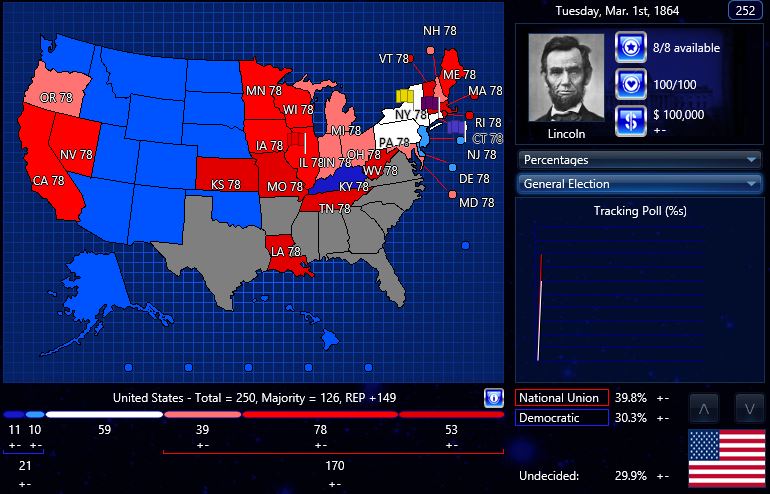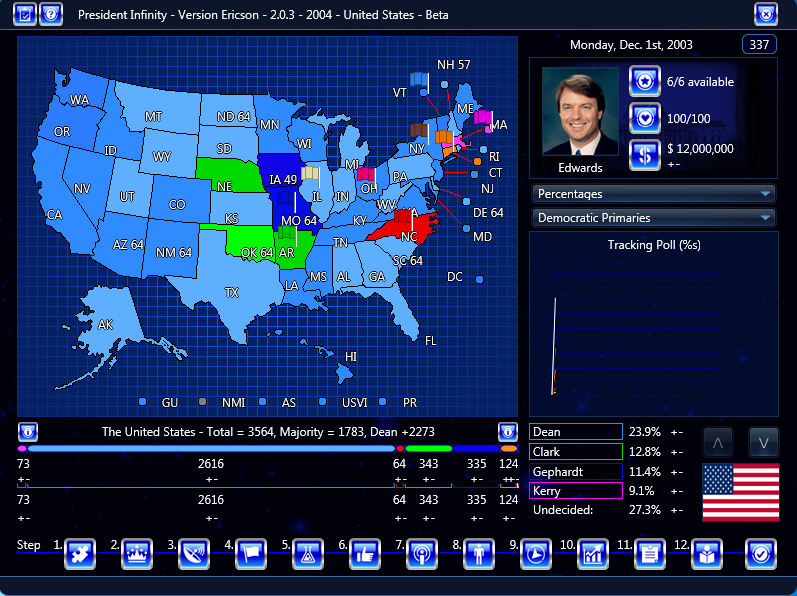
United States – 1864 – Alternate
This is based off of vcczar’s 1864 election campaign. I got his permission to use it.
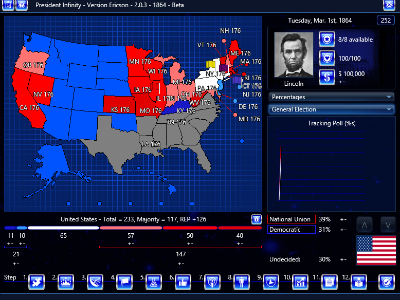
This is the what-if version of that. What if Tennessee and Louisiana’s electoral votes counted?
United States – 1864 – Alternate
This is based off of vcczar’s 1864 election campaign. I got his permission to use it.
This is the what-if version of that. What if Tennessee and Louisiana’s electoral votes counted?
*This scenario was updated greatly by the Historical Scenario Commission on July 27, 2017. Version 2.0 can be downloaded here: United States – 1860 v. 2.0
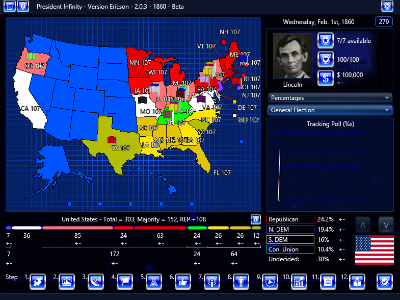
The 1860 election takes place at the door step of separation. The major issues are States’ Rights and whether or not slavery should be contained or spread. The Republican Party has moderated its platform since 1856 and is now a viable opposition party to defeat the Democratic Party. The Democratic Party has weakened and split due to fundamental differences between Northern and Southern members of their party. Former Whigs and Know Nothing/American Party members have formed a new party–the Constitutional Union Party–which hopes to hold the Union together by taking a moderate course based on compromise. Can any party prevent a Civil War?
For Republicans, the front runner is the leader of the party, William Seward. However, many in his own party do not want him to be president. As such, he faces tough competition from moderate and radical Republicans. Former representative Abraham Lincoln, a moderate Republican, has achieved recent fame for his debate on slavery against Stephen A. Douglas and for a recent recent speech at the Cooper Union building in New York City. Simon Cameron, Salmon P. Chase, Edward Bates and other Republicans are also in the race.
Northern Democrats are mostly rallying around front runner Stephen A. Douglas, who is an advocate for Popular Sovereignty on the slave question, which places him as a moderate. He faces a few challengers, but none that show a real threat to the nomination.
The Southern Democrats, have nominated their own candidates with sitting president James Buchanan’s VP, John C. Breckinridge, and Bourbon Democrat, Daniel S. Dickinson.
The Constitutional Union Party has an All-Star cast of rapidly aging candidates, including John Bell, Sam Houston, John J. Crittenden and others.
The Liberty Party fielded Gerrit Smith, a staunch abolitionist.
The election allows for many what-if scenarios:
Each candidate’s bio lists the result if they are election. For example, if the Civil War occurs or not. Some candidate may make the border states secede; whereas, some candidates may make New England secede.
Feedback is desired.
*This scenario was updated by the Historical Scenario Commission on July 27, 2017. Version 2.0 can be downloaded here: United States – 1864 v. 2.0
This election takes place during the Civil War. Despite the twin victories of Gettysburg and Vicksburg, Lincoln’s reelection is far from certain as the war seems far from over. Lincoln’s reelection hinges around military success. The Democrats, meanwhile, are split between Peace Democrats and War Democrats.
For Republicans, President Abraham Lincoln ran mostly unopposed (Grant, who was not running, would get token opposition votes from Missouri). Salmon P. Chase and Benjamin Wade considered running in the election (as they would in 1868), but ultimately backed out.
For Democrats, the front runner is General George B. McClellan, who was an adversary of Lincoln, whom the president removed from campaign following a very timid military career early in the war. He was a War Democrat, favoring continuing the war, but would follow the Peace Platform if nominated. Thomas H. Seymour, a Peace Democrat, and Charles O’Conor, a Bourbon Democrat, were his strongest competitors.
There are no ON 3rd Parties
This election allows for many what-if scenarios:
Feedback is desired
Version 2.0 (w/ events added by Davis Os)
*This scenario has been greatly updated by the Historical Scenario Commission on July 27, 2017. You can download version 3.0 here: United States – 1868 v. 3.0
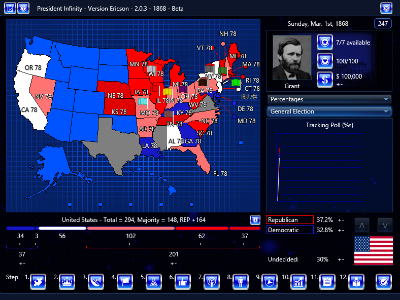
This election takes place three years following the Civil War and the assassination of Abraham Lincoln. The two major issues are the radical Republican brand of Reconstruction, which was a departure of Abraham Lincoln’s planned lenient Reconstruction, and the second major issue is charges of abuse of power against incumbent President Andrew Johnson.
For Republicans, the nomination was unanimous for victorious Union General Ulysses S. Grant, who had just recently declared that he was a Republican. Salmon P. Chase and Benjamin Wade, both of Ohio, had considered a run for the presidency, but dropped out when Grant jumped in. They couldn’t hope to compete with the leading living Northern hero of the Civil War.
For the Democrats, the party tried to show support for Andrew Johnson while also scrounging for a more competent replacement for him. Former Ohio Representative George H. Pendleton was the leading front-runner, with Thomas Hendricks, General Winfield Scott Hancock, incumbent President Andrew Johnson, and many others also in the race. However, a dark horse compromise candidate, who would have probably been the front-runner if he actively campaigned, was popular former New York governor Horatio Seymour.
No third parties are ON for this election.
This election allows for many what-if scenarios:
united states – 2012 special edition
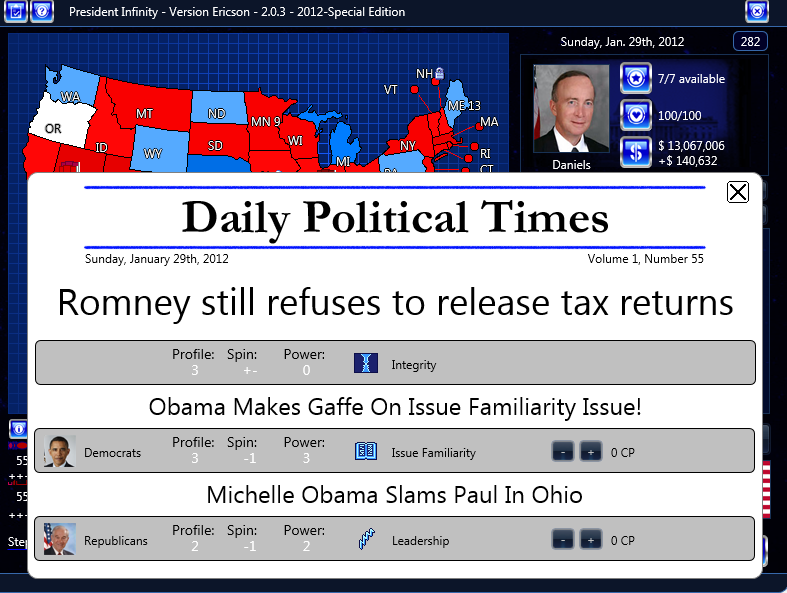
In 2008, Barack Obama was elected to the White House convincingly. Just four years later, he is facing a potentially difficult re-election campaign against a strengthened Republican Party. Now, as the Iowa Caucuses are fast approaching, Newt Gingrich has risen from the political dead and has taken the front runner mantle from Mitt Romney. Can Mitt make a comeback? Or will another candidate emerge? Or will the GOP have to draft a new standard bearer to enter the fray?
This scenario, inspired by the detailed accounts in the bestselling book Double Down, gives you everything you need to relive the 2012 race for the White House. Santorum’s surge. Rick Perry’s debating woes. Herman Cain and 9-9-9. Gingrich’s Moon Colony. Romney and the 47% tape. Bill Clinton’s DNC Speech. The debate in Denver. “You didn’t build that.” The 2012 race is on.
Features:
1. Over a dozen new campaign events, from Romney’s 47% tape, to Sandra Fluke, Todd Akin, and the Supreme Court ACA ruling, giving the election experience a much more thematic flavor.
2. Conventions are now more important: each night has a series of possible speeches, some that will benefit the nominee, and some that will hurt, but never is the same set of speeches delivered. Will Clinton’s DNC Speech win over undecided voters? Can Rubio give a new face to the GOP with his keynote? Or will Clint Eastwood wander on stage to talk to an empty chair?
3. CPAC-During early February, the GOP candidates muster at CPAC. Similar to the conventions, some candidates will do well and will gain critical support among conservative voters; others run the risk of stumbling, but the results are never going to be the same each time you play.
4. Candidates that dropped out before Iowa have been added back in. Can Herman Cain revive his campaign? What about Tim Pawlenty?
5. During the Spring of 2011, several popular Republicans passed on entering the fray; what if they changed their minds? Could Huckabee, Palin, Jindal, or Barbour emerge from the pack and win the nomination? What about Rudy Giuliani, Scott Brown, or Donald Trump?
6. When Gingrich and Romney were locked in their battle for the nomination, many Republican Party leaders vainly attempted to bring in a draft candidate to unite the party, even well into the primary season. Could Mitch Daniels, Chris Christie, Jeb Bush or Paul Ryan enter late into the race and still win? Or could they not get on all the ballots in time.
Note: While playing as a draft candidate, begin as undecided to simulate the lack of ballot access, and don’t have multiple draft candidates in the race. For a difficult challenge, stay undecided until February, or even March, when some candidates like Daniels and Bush still contemplated entering the race.
7. More endorsers: New endorsers have been added, like Colin Powell, Sarah Palin, and Grover Norquist. Be able to fund your candidacy for weeks by getting the backing of Sheldon Adleson or the Koch brothers.
8. New Historical Details added-Gingrich and Santorum have been taken off the ballots to Virginia, while the Missouri Caucus has been moved up to its correct electoral date (even if the delegates weren’t officially allocated until March), among other new improvements.
2004 U.S. Presidential Election Scenario
It is election season and America is at war. After 8 years of Democratic White House, George W. Bush narrowly won the Presidency. Since then, Bush’s plans have been derailed by terrorist attacks on 9/11. Bush responded by invading Aghanistan and Iraq. Now, as he faces re-election, Bush’s once towering approval ratings are declining. In face of two wars, a controversial election, and a sluggish economy, can Bush, like his father, end up as a one term President?
The populist Dean with his new internet fundraising. John Kerry and ‘flip-flopping’. The charismatic John Edwards. Joe Lieberman’s “Joementum.” Wesley’s Clark’s foray into politics. Karl Rove’s political machine and the Swift boat Veterans for Truth. Latinos cheering “Viva Bush.” Down to the wire vote getting in Ohio. The 2004 election is yours to write.
There are numerous what if scenarios:
1. What if Al Gore listened to the chorus of Democrats who wanted him to challenge Bush for re-election? Past Democrat Presidents who won the popular vote but lost the electoral college-Andrew Jackson and Grover Cleveland-managed to make a comeback and win the White House. Can Gore be next?
2. What if other high profile Democrats entered the race? Hillary Clinton was on the verge of making her own bid for the Presidency. Could have she won? What about other experienced Senate Democrats like Daschle, Biden, Dodd, could have they used their gravitas to make Bush a one term president?
3. What if Gary Hart, the Democrat who nearly beat Mondale, and some would say, paved the way for Bill Clinton’s New Democrats, embarked on a long shot comeback? He reportedly was close to making the plunge. Could Hart rise from the political dead and win the White House?
4. What if Lincoln Chafee continued his bid in challenging Bush as an anti-war Republican? Or what if Bush faced other primary challenges, such as from Colin Powell, Ron Paul, or his one time rival, John McCain? And what if Bush dumped Cheney for a more charismatic VP?
Note: I haven’t been able to figure out when the various U.S. territory primaries occurred, so they’re currently just on the days they were in 2008 (which I know, of course, is incorrect). I also need to update the U.S. Territory endorsers.
Version 2.0 by OS Davis included events, a few new issues, and two new minor parties: Equal Rights and Prohibition.
Version 3.0 was updated by the Historical Scenario Commission on July 27, 2017. Download here: United States – 1872 v. 3.0
*****
The 1872 election is one of the most bizarre elections in our history. President Grant’s first term was highly controversial, involving scandals and Radical Republican Reconstruction legislation. The corruption of the administration bothered both Democrats and Republicans. However, Grant was still personally popular, as he was perceived to have been mostly beyond the scandals of his administration. As such, a disorganized Democratic Party, weakened by Reconstruction, united with unhappy, reform-minded Republicans in strengthening a new party–the Liberal Republican Party.
For the Republican, Grant and his backers had such a strong hold on that party, that he was unchallenged for the nomination, despite the controversial first term.
The Liberal Republicans field many interesting candidates, but none as powerful a figure as President Grant. The leading candidates were:eccentric newspaper editor, Horace Greeley, and former ambassador, and son of president John Quincy Adams and grandson of president John Adams, Charles Francis Adams, who had kept the British from aiding the Confederacy during the Civil War. Other candidates include popular Missouri politician Benjamin Gratz Brown, well-known civil right activist Lyman Trumbull, Supreme Court Judge David Davis, Chief Justice of the Supreme Court Salmon P. Chase and ambassador Andrew Curtin.
The Bourbon Democrats is the third part for this election. They were conservative, pro-business Democrats that would not endorse the Liberal Republicans. The candidates selected were Charles O’Conor and John Quincy Adams II, the son of the ambassador mentioned above. Both candidates refused to join this third party, but they were on the ballots anyway.
This election has many what-if scenarios:
For the best effect, it is best that you turn off the Liberal Republicans and the Bourbon Democrats, if you turn the Democrats ON. However, the game is still highly playable if you play as every party. However, keep in mind that some politicians belong to more than one party in this scenario.
Feedback is desired.
*This election was updated by the Historical Scenario Commission on August 15, 2017, and can be downloaded here: United States – 1876 v 2.0
The 1876 election is one of the most controversial elections in history. Reconstruction was winding down, which meant the Southern White conservatives were regaining political power from the Northern Republicans, and some African-Americans, that had replaced them following the Civil War. As such, many of those in power prevented African-Americans, and even White. Meanwhile, the Republican party was accused of controlling the election in the South, partially through the governors still in place from Reconstruction. This lead to a constitutional crises called the Compromise of 1876.
However, leading up to this election, the main issue was whether or not President Ulysses S. Grant would run for a 3rd term. Most people expected him to run, but his advisers convinced him not to, as James G. Blaine’s Half-Breed (moderates) seemed set to win, due mostly to Grant’s corrupt administration. With Grant out of the picture, Democrats expected to have their first shot at the presidency since the 1856 election, and only four years after the Democratic Party’s collapse in 1872. It should be noted that this election takes place 100 years after the founding of our country.
For Republicans, James G. Blaine emerged as the new front-runner. However, he had his own scandalous past that would not be overlooked. Benjamin Bristow promised to be the reform candidate, as he had helped Grant clean out much of the corruption in his administration. Oliver P. Morton and Roscoe Conkling ran as the Radical Republican options, which still wanted to punish the South. Other candidates contested the nomination as well, but the most promising is Ohio governor Rutherford B. Hayes, who was a known reformer and moderate.
The Democrats, emboldened by the reestablished former Confederate base, decide to nominate conservatives for their ticket. The nearly unanimous top choice is Bourbon Democrat Samuel J. Tilden, a strict constitutionalist, pro-business, pro-Gold Standard democrat from New York. The two distant rivals are main-line Democrat Thomas Hendricks and the politically ambiguous Civil War general Winfield Scott Hancock. Other candidate are also in the race, but have an uphill battle.
The Greenback Party led by the wealthy industrialist, Peter Cooper, is the 3rd party option. Although from New York City, his base is mostly in the Midwest and West.
This election allows for many what-if scenarios:
Feedback is desired.
*This election was updated by the Historical Scenario Commission on Aug 15, 2017. It can be downloaded here: United States – 1880 v 2.0
This election takes place at an early stage of the Gilded Age. Corruption, currency and the tariff were major issues. Also impacting this election is President Rutherford B. Hayes fulfilling his promise to serve only one term. His election in 1876 resulted in a compromise, as the election was close enough that many Democrats felt it was stolen from their candidate, Samuel J. Tilden. As such, integrity became a key issue as well. This election also marks a point in which many former Confederate officers and politicians were elected as US politicians.
The Republicans, with Hayes declining to run for reelection, were split between the Stalwarts (Conservatives) and the Half-Breeds (Moderates). former president Grant is urged to run for a non-consecutive 3rd term by the Stalwarts, and he start off as the front-runner. His primary challenger is James G. Blaine, who leads the Half-Breeds. Both of these leaders have had a history of corruption. Therefore, the alternative choice is former Senator John Sherman, the brother of General William T. Sherman. Other candidates also make an attempt for nomination. However, there is a rising Dark Horse candidate named James A. Garfield who seems likable by all sides.
The Democrats want their 1876 choice, Bourbon Democrat (Conservative wing) Samuel J. Tilden, to run for the nomination again. He declines, leaving an open field. The front-runner is Civil War general Winfield Scott Hancock, who appears to be something of a moderate Bourbon Democrat. His main competition is Bourbon Democrat Thomas Bayard. A field of many other Democrats along the political spectrum run for the nomination as well.
The Greenback party is the 3rd party for this election.
This election allows for many what-if scenarios:
Feedback is desired.
*This election was greatly updated by the Historical Scenario Commission on August 21, 2017, and can be downloaded here: United States – 1884 v. 2.0
This election took place in the early stages of the Gilded Age. Railroad regulations, currency reform, tariff reform and civil service reform were key issues. The sitting president, Chester A. Arthur, had become president on the assassination of James A. Garfield. His presidency upset many in his own party and his reputation as a lazy administrator also did much to hinder a strong reelection campaign. As such, he faced many challengers. The Democrats also liked their chances of finally defeating the Republican party.
For Republicans, James G. Blaine, the leader of the moderate Republicans, known as “Half-Breeds,” was the front-runner. They favored a more bipartisan platform, but Blaine still suffered from a poor reputation due to previous scandals. The incumbent president was the favorite among former “Radical Republicans,” which were more conservative economically, but also more in favor of enforcing Civil Rights in the South. Many other major candidates such as George Edmunds, John Sherman, John Logan, and Joseph Hawley hope to win the nomination.
The Democratic front-runner is the popular Bourbon Democrat (fiscally conservative and strict constitutionalist), Grover Cleveland. His personal integrity was high, but rumors of a child out of wedlock negates what could have been a great strength against Republican front-runner Blaine. Cleveland faces challenges from other Bourbon Democrats, as well as Populist Democrats and Southern Democrats.
The Greenback Party led by Benjamin F. Butler and the Prohibition Party led by John St. John
This election has man what-if scenarios:
Feedback is desired.